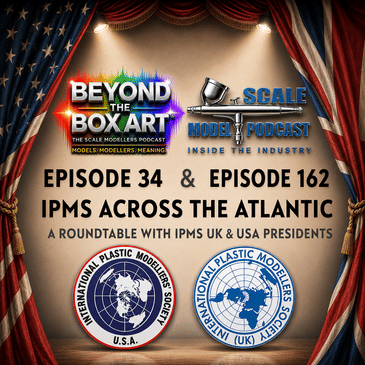






Beyond The Box Art® — Episode 34
Scale Model Podcast — Episode 162
Across the Atlantic — IPMS UK & USA Presidents - TOGETHER!
Hiya Benchmates — Episode 34 has landed, and this is one we've genuinely been looking forward to for a very long time.
For only the second time, Beyond The Box Art® joins forces with our great friends at The Scale Model Podcast for another special transatlantic collaboration, bringing together voices from both sides of the Atlantic for what has become a truly landmark episode.
This time, however, we're making a little bit of history...
🎙️ Feature Discussion — The First Public IPMS Presidents Round Table
For the first time ever, the Presidents of IPMS UK, IPMS USA, and IPMS Canada come together publicly for one conversation.
Joining Brownie, Balders, Dan & Shane are Terry Miesle and Geoff Heyland, plus:
• Ian Middleton — President, IPMS UK • John Noack — President, IPMS USA
Together they discuss the future of IPMS, attracting new generations of modellers, supporting clubs and shows, the challenges facing modelling organisations around the world, and why the hobby remains as relevant today as ever.
Rather than a formal interview, this is a genuine round-table discussion between friends who all share the same goal — ensuring scale modelling continues to thrive for many years to come.
There are thoughtful discussions, plenty of laughs, a healthy amount of good-natured banter, and more than a few moments where international diplomacy is tested over plastic kits.
⭐ Stash Inflation Report
The team's wallets once again take a considerable battering as they round up the latest kit announcements, aftermarket releases and modelling temptations from around the world.
Aircraft, armour, naval subjects, Gunpla and everything in between all come under the spotlight, with plenty of opportunities to add "just one more kit" to the stash.
As always, expect a few questionable purchasing decisions, several enabling comments, and at least one declaration that "I definitely don't need another one..."
(We all know how that ends.)
This episode is more than simply another podcast.
It's a celebration of what can happen when modelling communities work together rather than apart, proving that while our accents, club badges and favourite subjects may differ, we're all united by exactly the same passion for scale modelling.
We sincerely hope this becomes the first of many annual conversations bringing together IPMS organisations from around the world.
So grab a brew, pull up a chair at the bench, and join us for a truly international conversation celebrating our hobby.
Beyond The Box Art® Episode 34 & The Scale Model Podcast Episode 162 starts NOW!
Brownie & the Beyond The Box Art® Team Models. Modellers. Meaning.
Contact
Email: info@beyondtheboxart.com Website: www.beyondtheboxart.com
Show Sponsors
AMMO by Mig Jiménez — www.ammo.es Fischkopp Model Company — https://www.fischkoppcompany.de/ Guideline Publications — https://www.guidelinepublications.co.uk/ Phase Hangar Resin Accessories — https://phasehangarresin.com/ The Scale Modellers Supply — https://www.scalemodeller.com.au/
Useful Links
Pondstones — https://pondstones.sumupstore.com MachModels — https://www.youtube.com/@machmodels 48 in 48 event information — https://48-48.org Models for Heroes — https://modelsforheroes.org.uk Eduard — https://www.eduard.com/ Airfix — www.airfix.com Revell — www.revell.com IPMS UK — www.ipmsuk.org Scale Modelling Now — http://www.scalemodellingnow.com Inside The Armour — https://www.insidethearmour.com/ Red Beach One Studios — https://www.facebook.com/RedBeachOneStudios/
Useful Links
🎙️ Why Listen to Beyond The Box Art®?
Beyond The Box Art® is the modelling radio show on the internet, bringing together modellers from around the world through:
• In-depth interviews with industry leaders, manufacturers and hobby personalities • Honest discussions about kits, techniques and the ever-changing modelling world • Coverage of clubs, shows and the people who make the hobby special • Support for modelling charities and initiatives that use the hobby to improve lives • Plenty of humour, friendship and the occasional excuse to buy just one more kit...
Available free of charge wherever you get your podcasts.
[00:00:04] Hiya Benchmates, and welcome to a special combined episode of both Beyond The Box Art and... Welcome to the Scale Model Podcast. In this podcast we aim to entertain, inform and promote the hobby of scale model kit building, with interviews, reviews and news about the hobby.
[00:00:26] No matter your scale, subject or skill level, you're among fellow Benchmates. Welcome to Beyond The Box Art, the Scale Modelers Podcast.
[00:00:51] Joining us for episode 34 of Beyond The Box Art and episode 162 of the Scale Model Podcast, we have the first ever round table with the presidents of IPMS UK and USA TOGETHER. Hi Benchmates and welcome to a very special episode of Beyond The Box Art, which is also our second joint episode with our colleagues from across the pond of the Scale Model Podcast.
[00:01:19] To help fill the show's hiatus whilst Stuart is kept busy with a day job and looking after his better half. And something we will continue to do until the show is ready to come back under its own steam. Anyway, in this episode, the word special is doing rather more heavy lifting than usual. We're aware that a lot of our Benchmates will be listening to this episode on the journey to Fort Wayne for the IPMS US Nationals. So, please drive safely and have a great show. Hopefully one year we'll get across the pond to see it for ourselves.
[00:01:47] Now, when planning to make this joint episode with the crew in Canada, I arranged a long overdue chat with John Millack, president of IPMS USA. And during my brainstorming phase of fanning, this isn't just thrown together. We are joined in episode 32 by Rich Middleton, president of IPMS UK to launch the world's largest scale model show. Shots fired, Brownie! That's going to be held in Telford in November, which you can obviously go back and listen to that episode on your way back from Fort Wayne.
[00:02:16] So, one of those mission creep ideas has now turned into presidents of both IPMS USA and the UK being on the show together, which is going to make for a very interesting conversation, one that has been long overdue. And who knows, hopefully this will be the beginning of something that will be an annual event, bringing presidents from IPMS from across the globe together.
[00:02:39] But before we get anywhere near presidential matters, we need to introduce the team responsible for attempting to keep this particular international summit vaguely under control. So, joining us once again from the scale model of podcasts, we have two gentlemen who have become familiar voices to our Benchmates. First, a man that continues to prove that geography is no barrier to appearing on a podcast that forgets to lock the Zoom meeting. The one and only Mr. Terry Measley. Greetings from balmy Chicagoland.
[00:03:06] And along with Terry, representing the more sensible end of the scale model podcast from the Canadian side, although that's an extremely low bar to actually have to go for. From the north shore of Lake Erie, we have Mr. Jeff Hayland. Hello all, and I've never been called a gentleman before, so that's a new one. Okay, I'll chalk that one up, cross that one out in the edit. So, representing the Beyond the Box art, we have the usual collection of highly trained broadcasting professionals.
[00:03:32] Unfortunately, none of them are available, so instead we've got Mike Baldwin, a.k.a. Balders. Hello everybody. And we have Shane Cowie. How's it going Benchmates? And yours truly, Paul Pendleton Brown. My friends call me Brownie, so let's be friends. But before we get our presidential guests to go into their official capacity, we're going to go exactly where we should do at being scale modelers. And that's what's on your bench. So, this is episode 34 of Beyond the Box Art. Episode 162 of the scale model podcast.
[00:04:02] And this episode starts now. So, gentlemen, let's find out what we've been working on the workbench. Let's start with President IPMS USA, John Nowak. Welcome to the show. Thank you very much, sir. I appreciate it. What is on my bench?
[00:04:31] I just finished a 172nd scale, which is my preferred scale Cayman Sea Sprite, an anti-submarine helicopter in the old beautiful blue and yellow markings. And because I'm an eclectic modeler, I have moved on to doing a 1920 T-bucket hot rod of some sort. Color scheme you have to be determined. Choice of engine you have to be determined. If you looked at my workbench right now, it is carpet-bombed with various engine parts from various kits, some of which may actually fit together to become a supercharged V8 engine. But one never knows.
[00:05:01] Okay. And obviously, Rome, role of President IPMS USA keeps you busy a little bit at the time. Sometimes. The day job, in inverted commas, is an interesting one as well, which I'm sure our bench mates will be interested to find out what you do. Thank you. I appreciate that. Yes, I am retired from the aerospace industry. But about five years ago, I had the pleasure of going up to the Air Force Museum here in Dayton, Ohio, which is about 10 miles from my house, becoming a gallery monitor,
[00:05:28] which basically involves telling people where the restrooms are and please don't jump on the airplanes. And then eventually working my way up to a docent, where I now give tours. I work with the education department. And this year, I am the lead volunteer of the 500 or so volunteers in place at the museum. So I get to taste, touch, lick and feel historic aircraft and spacecraft, which is my great joy. On Mondays, I clean artifacts and I've had the pleasure of climbing on and over various one of a kind aircraft and spacecraft
[00:05:55] and taking dust and bird poop off of it, which doesn't sound exciting until you realize that you're touching history, not the bird poop, the aircraft. I gather that bit. And obviously we're recording this a little bit in advance of the episode going out, but over the last couple of days, you've been actually a fondling Fifi. Yes. So we had the pleasure at the Air Force Museum of having one of the world's two flying B-29s come in for a three day visit. And I was out there as she landed, which was a beautiful sight to see.
[00:06:22] And then we had probably three or 4,000 people go through the aircraft in Balmy, a 90 degree Dayton, Ohio weather, 90 degree Fahrenheit, I might add. And that was quite an experience. So it's, it's again, touching history is a strong part of why I volunteer at the museum. Although my own volunteer job, which we'll talk about. Absolutely. And I, I should imagine in the very near future, you can have a 747 joining the collection as well. Yes. And interestingly enough, you mentioned that most of my tours are in that particular building.
[00:06:49] I have been told that we will be able to fit that VC-25 or 747 in the building without removing any of the existing aircraft that are in there. So the day that happens, we'll be air clean Jenga on a great scale. And I intend to be there to see that happen. So I can imagine, but after Air Force One was replaced, it's now back in service again. Yes. So I hear it. Must admit personally, I prefer the old scheme rather than the new scheme, but we won't go down that rabbit warren today. Yes. Good idea.
[00:07:15] Okay. So with that, Rich Middleton, president IPMS UK. Welcome back to the show, Rich. Glad to be back and glad to meet you, John. Same here, sir. And what have you got on your bench then, Rich? Too much as usual. One of my other roles is to head up the car and motorcycle seat here in the UK.
[00:07:36] So this year, you'll get a bit of a special display going on. It's the 50th anniversary of the BW Golf GTI this year. So I've got three of those on the bench and the potential fourth to follow. So that's keeping me occupied. We're not displaying them, sharing them on any media or anything until the event. So it's a bit of a surprise for everybody. So we did it a few years ago with a 2CV build and that went down really, really well and very eclectic interpretation of what you can do with a 2CV.
[00:08:05] So hopefully the plan is it will happen again with the Golf. Any Golf, doesn't matter what mark, which manufacturer in terms of the plastic, it's just Golf rules basically. So that's some of it. I've been playing around chopping up a Tamir 4G and a Tamir 4 Mustang GT4. That was going to be fun when that's finished. That was on the back of an AI I saw online months ago. It actually works. I'm just going to make it stick together now.
[00:08:34] And I've also started a Heinkel 111, the Airfix modern issue kit, not the old plastic one, simply for the fact that one was shot down and landed approximately two doors from our front door here during the war. So very much a local connection to that one. Oh, that'd be interesting to see. And also I should imagine the Revelle re-release of the Golf came rather timely for you. Or did you already have them in stock? I did have one. I've now got two.
[00:09:01] Earth. But we've managed to do a deal with models for sale for the SIG, but we've been able to get a box load of the Ituleri reissued Eshi ones. Mm-hmm. Okay. So we've been using those as the basis. Basically they're cheap enough where it doesn't matter if you chop them up and what you do with them. Fair enough. Hey, Rich, if you were to build nine of them and set them on the table, you could do a round of mini golf. Awesome. Oh, a hole in one. Oh, Shane knows all about that. We'll get him started, Brownie.
[00:09:30] Yeah, I don't want to go too much into that. That's too expensive boys. That's too expensive. Fair enough. And what have you got on your workbench? So I have got the Challenger 2 pretty much built actually about 90% built. And I'm really happy with it actually, how it's turned out so far. It's definitely in my stretch zone. So the first armor kit that I've ever built. So yeah, learning, learning a lot as we go along.
[00:09:54] Utilizing the knowledge of our bench mates as well. So thanks to those that replied to my post on, on Facebook asking about iridescent glass and what to do. So it sort of delayed the build slightly. But yesterday I got some color shift vortex from SMS and I started spraying that on some bare sheet and it's really effective.
[00:10:18] It gives you that iridescent look that I'm looking for. So thank you very much to, to the bench mates that made that recommendation for me. Is that pretty thinned down or just like one coat does the job? Yeah. Yeah. So it's obviously the great thing about SMS paints is you can spray it straight away, but you're very, very, very light, very light. Interesting. And you can just get this lovely sort of goldy sheen. Mm-hmm. You know, that's something definitely to play with. Yeah.
[00:10:48] Yeah. You probably not about to pick it up on camera, but it's really effective. You can, you might be able to actually, I appreciate our listeners won't be able to pick this up, but you can just see a gold, goldy red, almost like a greeny sheen to the plastic. That is effective. Yeah. That's something definitely to experiment with. It's really cool. You could have cut, you could have cut your window out square though. Yeah, I could have done. It doesn't have to be square brownie. That's true. Is it fitting on the inside? It doesn't have to be square.
[00:11:16] This is true. Good point. Well made. Okay. Is that all you got on your bench or are you being good? Yeah. So I'm, I have been really, really good. I've just waited for those paints to turn up and yeah, I've just been trying to enjoy the process of this, this armor kit because it taking the time of it, it's all new. And I want to do a good job and I want to do it justice. So that's pretty much it for me. It's obviously been far too hot over the few weeks to, to do any air like the airbrushing.
[00:11:42] So it slowed it down a little bit, but it means the build can be a little bit more accurate, hopefully. So. Just say to your wife, because of the heat, you're actually building in this a bit slower just to save some money. Yeah. I'll use that one. I'll see what she says. I'll let you know what she says on that one. We'll wait to see the black eye on Tuesday. Yeah. Shane, when it comes to painting, because I presume you're doing the desertized one. Yes, indeed I am. I'll send you the combination to get the correct color. Oh yes, please. That'd be very, very good.
[00:12:11] It's a few mixtures. It can be a paint, but one of the guys that heads up the modern British armor SIG gave me the formulation for it and it comes out pretty bang on. Ah, perfect. Yeah. That'd be spot on boulders. Yeah. Thank you for that. So I'll, I'll send it across to you. Thank you very much, sir. Okay. Jeff, what have you gone on the bench since we last had a conversation? Well, I've had, I jumped from one thing to another and, what's holding me back is the same thing that Shane was talking about getting some airbrush time.
[00:12:40] I just need to sit down and do it. But every, the first Thursday of every month, a bunch of us from the club get together at the local Legion for a build night in person. And we drink beer and eat hamburgers and build models and slag off each other basically. And it's always entertaining, but you have to bring, you have to bring a, some kind of a kit that you can work on there that you don't need your full complement of tools and you can't do any painting or that kind of stuff.
[00:13:06] Just don't have the facilities. So I just usually pick up a, whatever I've got from the stash that looks odd, weird and different. And this is what I've been building. It's an ancient plastic cart, like ex East German model of the Beriev BE-6, which is a seaplane from the Soviet Union time. And the kit is terrible. It's just a horrible kit, but I love horrible kits and I love weird subjects. So it's kind of entertaining and kind of fun. And the nice thing about horrible kits is yeah.
[00:13:36] If you screw it up, who cares? So that's a very much a liberating experience for me right now, but that's what I'm working on right now. But I just finished a 1-700 scale Essex, USS Essex carrier that I now have to sit down and do some kind of dazzle camouflage scheme on, but I got to get the airbrush going. So that's next on the list. So we'll see, but that's where I am right now. Fair enough. Okay. In that case, let's move on with boulders. What have you got on your bench?
[00:14:04] My annual build competition, which I am still not naming because obviously there are listeners about. So that is being kept under wraps. It is 144th scale. That's all I'm going to say. But I do have some other things on the bench. So I've started a 1-32nd Hazigawa P47D Thunderbolt. Contemplating on what colour scheme to do that, because it is Grabeski's.
[00:14:30] And I don't know if I want to do that or if I want to do a British SEAC one over in Burma. So it's tall. You can go to town with weathering on both of those. Yeah. Absolutely. Absolutely. I have done some SEAC ones. I did a Hurricane from 17 Squadron in 32nd scale. That was in Burma, but that was just an unusual camouflage scheme.
[00:14:56] Unusual roundels on it because the Type B roundels they had to remove because people thought they were Japanese aircraft whilst they were on the ground and were getting shot at. So they reverted back to Type A roundel. So to obviously give people from above the clue that they weren't Japanese aircraft. So yeah, I've gone back to Warcraft for the first time in 12 months.
[00:15:19] But there is another ship on the go and you can blame Neves for this one because we mentioned it in the last episode. I snuck a cheeky bid in and didn't realize I'd won it until I got a phone call off the seller to say, you need to pay for it. And I was like, pay for what? And they were like, so I was like, oh, didn't realize I won it. No notifications or nothing. So I managed to get hold of a Dragon 1350th Sharnost from 1943.
[00:15:49] And it's an absolute gem of a kit. It is stunning. The instructions are a bit to be desired. As all Dragon kits are. If you can figure them out, then you've got a PhD in astrophysics. They're more of a suggestion than actually useful for construction. Yeah, it's just, I just don't know what it is with Dragon instructions. They just make things 10 times harder than they need to be. But the kit is absolutely superb. Came with a load of reference material. Came with three bucks with it.
[00:16:18] Came with loads of photo etch. And I got that for 90 English pounds. The kit is 180 pounds in the UK. If you can get hold of it. So I got it for half price. So bargain, McBalders struck again. Hold on. Let's have a look. No, $120.61. Okay. So that one is going to be done as quite a large dio because I'm going to convert a
[00:16:48] time of your 350th King George V or a Prince of Wales into Duke of York. And I'm going to have it battling against each other. As in they did on Boxing Day of 1943. So you're going to go for Seascape with resin or are you going to go with the Wongi version? I'm going to do Wongi's version because it's a lot easier, a lot quicker. Not so heavy. Yeah, it's not so heavy because obviously the thing is with resin is even if you put it on
[00:17:17] the board, if the board flexes. Yes. You're putting pressure on the resin so you'll form cracks. And what I don't want is for it to snap. So I'll use my favorite XPS installation foam board, put some filler on it to do some bar waves. Obviously it was December 43. So the sea was rather choppy, rather black because it was at nighttime. So that's what I will be concentrating on.
[00:17:43] So that is going to be a lengthy build because I'm going to have to build two battleships to do that. But yeah, I've dabbled in back into aircraft just to keep me toes wet. If I may just interject for a second, your comment about resin and the bases. I built a Sikorsky Vacuform, the S-43 seaplane, put it in its base, poured resin into a wooden base that I had milled out with a router, came back two days later and my wooden base had turned into a taco.
[00:18:11] Ah, it actually bowed up about an inch at either end with the model firmly embedded in the resin. So yours truly had to take some under grit wood sandpaper and carefully grind the base of this diorama with the model on it until I could achieve some degree of flatness. So I resonate with the comment about resin, no pun intended, and shrinkage. Fair enough. That is something. How thick was the base? The wooden base? Probably about half an inch. Not enough to withstand the shrinkage factor of the resin, I guess.
[00:18:40] And was that a ply or was that actually a perm? Um, it was maple, but I guess now that I think about it, once I had ratted out the cavity, the base remaining was only about maybe an eighth of an inch. Ah. Where I had created the depression for the resin, so there wasn't any wood to resist the shrinkage of the resins. Lesson learned. It's a useful tip for everybody else. It's the same with MDF as well, Browner. If you don't put a curtain on it before you put the resin down, it'll just sink it, it'll just soak in, and it'll just expand, and it just splits. Gotcha. Okay.
[00:19:10] Well, with that then, Terry, why have you gone on your bench? Well, off the bench is that thousandth scale Hyuga from the Amatoverse. Sent you guys pictures of that a couple weeks ago. All the fighters are on it. Did you leave the tugs on there? Leave the tugs on there? I'm still not completely satisfied with the tugs. They look okay, but I think I'm going to try to find a way to do them better. Honestly, cast them out of a little, it's just a sign and strip I use to make them. And the castings are not fantastic.
[00:19:38] It'd be easier just to make the whole thing out of strip. But I'm also going to see if I can't get some tiny tugs printed. The thousandth scale, that's a high detail printer. Yes. But they're not permanently attached, so I can remove them and bring them back. There's no crew in thousandth scale. Why not? In little bits of plastic. In progress, a couple other Yamato stuff. I got the core ship still going. That shouldn't be too long.
[00:20:03] The autonomous Cosmo Zero, the black one, the remote controlled ones that they were using. I found a Reaper. Reaper miniatures, if you're familiar with the fantasy miniatures. They're direct 3D printing now. They had done their bones material, which was a plastic, flexible casting stuff, which was great. They were light, but they were a pain in the ass to clean up. You had to kind of wet file the seams off them. But the 3D printing is fantastic. It looks really good.
[00:20:31] It didn't take much cleanup under a bit of primer. There's no stepping or anything like that. So I'm painting a Reaper dwarf. He's a dwarf brewmaster. It's got a barrel under one arm and three beers in the other. So doing that, I'm also reinstituting my rule to get something out of the shelf of doom. And before you start a new one and kind of going that way.
[00:20:55] So I pulled out a 35th scale Italiana, the desert car that I got to about 70% done on and then put it away probably 10 years ago. I need to start putting cards in there where I write when I put them on the shelf. So I remember how long it's been. It looks okay. I think I'll do all right. And I'm not going to, to Jeff's point, I'm not going to put in a lot of effort, even though it's got to be dusty. You got to dust it up a little bit. But Saharan is a cool little car, so I've got that.
[00:21:25] I'm going to start painting some more thousand scale fighters from the Automataverse. I pull them out of some kits. And if anybody wants to send me some spare 1000 scale fighters, please do. I'll paint them. Obviously a masochist. Oh no, no. I bit my teeth. I started in the hobby, well, blowing stuff up, but also miniatures for fantasy miniatures and stuff. So I've been painting this small stuff forever now. Getting back on the saddle a little bit with a dwarf. It's been kind of fun, but a few years is enough to lose a lot of skill.
[00:21:55] And then you come back to it and you've got to decide what you do. So I'll never be a master of any of it, but that's fine. They look good enough. As long as you're getting, as long as you're getting enjoyment out of the hobby, that's all that matters. Yep. I did find they put a whole bunch more bar scene stuff out from Reaper. So waitresses, patrons, drunkards, tables, all this stuff. So maybe I'll buy a whole bunch of it and make a little scene. Hang on. Are you talking about your normal modeling club or are you talking about? Well, that's today.
[00:22:25] I think he just described the Fort Wayne convention, but I'm not sure. You were in Madison, right? Yes, sir. V town. Yes, sir. It sure is. Drunkards and Dwarves. You're being heightist now. No, the race. Yeah, not just height. Yeah, yeah, yeah. Maybe more swiftly. There are halflings in there too. Okay. Fish Cop Models.
[00:22:53] Elevating scale modeling to an art form. Experience highly detailed 3D printed upgrade parts that bring true authenticity to your builds. Creators of the acclaimed Rolls Royce Merlin engine set for both the Kotari Spitfire and the Dambusters set for the Border Models Avro Lancaster. For bespoke design and printing, our service is as precise as it is personal, all at a reasonable price. Please take a look at our products on www.fishcopcompany.de.
[00:23:20] Shipping is available for all of our products worldwide. Beyond the Box Art is proudly supported by Ammo, by Meg Jimenez, The Scale Modeler's Supply Guideline Publications, Phase Hanger Resin Accessories, and Fish Cop Model Company. It's time for the Stash Inflation Report, proving that storage space is finite,
[00:23:49] but apparently model releases are not. Well then, Benchmates, you know what time it is. Welcome to another edition of the Stash Inflation Report, the part of the show where we collectively convince ourselves that buying another model isn't spending money, it's preserving aviation history. The manufacturers certainly haven't taken the fortnight off, whether your interests lie in classic airliners, iconic warbirds, cutting-edge military hardware, or beautifully engineered special editions.
[00:24:18] There are plenty to have, and let your finger over and over that pre-order button before we've finished. So if you're hoping your wallet might get quite an episode, I'm afraid you're listening to the wrong podcast. Let's get things underway with a few civil aviation releases, before we dive headlong into fighters, bombers, helicopters, that are almost guaranteed to find a way onto your workbench eventually. AMP have announced 144th scale Dash 8 Q400MR,
[00:24:46] in French Securite Civil Markings, a really unusual firefighter rescue aircraft that makes a refreshing change from the usual airliner releases. Staying with AMP, there are also several versions of the distinctive 1-72nd Britain Normal Trilander in Arrhenia schemes. Three engines, an unmistakable silhouette, and a perfect subject if you enjoy something a little different. If you enjoy something a little different. For regional airline fans,
[00:25:13] A&A models have a 144th Fokker 50, while X scale are taking us back to the dawn of the jet age, with a beautifully elegant 144th scale Boeing 707-120B. Now then, that's enough for the sensible purchase. Azigawa are back with a strong lineup, including a 70th anniversary F-15J, an eye-catching F-14B Tomcat, complete with 3D printed exhaust and photo etch,
[00:25:41] an impressive 1-48th FA-18D Hornet, and the latest AH-64E Apache Guardian, and a stunning black special scheme Saab Draken that's bound to attract plenty of attention. Tigerhead models continue to expand their range with a Turkish Air Force Curtis Kitty Hawk Mark 1, alongside a highly detailed BF109K14 Kurfürst, featuring Edouard tooling, resin extras, and plenty of finishing options.
[00:26:09] Trumbeter bring us the rugged MI-17 1-H hip, Academy revisit one true classic with a 48th F-86 F-40 Sabre, and Hong Kong models have announced their impressive B-25J Straffer, complete with its fearsome battery of forward-firing 50 caliber machine guns. Rode and round things off with a lovely 144-scale short Sunderland, one of the most famous flying boats ever built, and a subject that's always welcome to see returning.
[00:26:39] If that wasn't enough, Edouard have released their Sharks and Stallions dual combo, pairing the P-40N Warhawk with the P-51B slash C Mustang, packed with multiple marking options, resin, masks, and four-twetch. Special Hobbit continue their relentless release schedule, with a Martin Baltimore, Bucker Bestman, and a highly detailed Curtis P-40M Warhawk. While Aero model add three versions of their elegant Piper PA-46 Malibu family,
[00:27:07] for those who prefer their aviation with a little more civilian. So there we are, a thoroughly respectable selection of aircraft releases, that collectively have probably added several feet to our stash shelves, and completely destroyed any hope of financial restraint. Unfortunately for aviation fans, that's where my damage ends. Unfortunately for everybody else, the armoured manufacturers have just been as busy. Dan, what have you got for us in the world of AFVs? Thanks, boulders. Well, if aircraft aren't your thing, don't worry, it's time to head back down to Earth,
[00:27:37] where everything's covered in mud, smells of diesel, and weighs somewhere between 20 and 50 tonnes. Got a nice mix this time, with an enormous interwar Soviet monster, to one of the strangest Volkswagens, to everywhere military colours. And finally, a very large British Chaffee, that definitely demands plenty of shelf space. We kick things off with something a little different. Night Sky Miniatures have released a 3D printable T-35A heavy tank, and if ever there was a vehicle that proved Soviet engineers
[00:28:05] weren't afraid to think outside of the box, this is certainly it. The T-35A was one of the most recognisable tanks ever built, thanks to its extraordinary five-turret layout. Designed during the 1930s as a breakthrough heavy tank, it certainly looked intimidating, even if real-world combat proved that complexity wasn't always the best idea. By the time Germany invaded the Soviet Union, most examples had been lost through mechanical failures rather than enemy action,
[00:28:33] but it's remained a favour with armour enthusiasts ever since, because it simply looks unlike anything else ever before or since. Matthew Devonish has designed this release specifically with tabletop gamers and display modellers in mind, striking a balance between durability and detail. The files include pre-supported and hollowed options, separate or one-piece hull and track configurations, and the flexibility to print the tracks independently
[00:29:03] for maximum detail, or as a complete assembly if you'd rather save yourself a bit of time. And if you've got a resin printer sitting at the bench, it's certainly an unusual subject that will grab plenty of attention. Next up is a brand new tooling from Daswerk. Their 135th scale Volkswagen Type 181 Standard represents the basic courier version used by the Bundeswehr, Dutch military and civilian operators. Most people will know it by another name,
[00:29:32] the Volkswagen Thing, although depending on where you lived, it was also called the Trekker, Safari or Courierwagen. Originally introduced as a simple rugged utility vehicle, it was designed to be inexpensive, reliable and easy to maintain, borrowing a proven Beetle mechanicals underneath. While it lacked the four-wheel drive, the rear-mounted air-cooled boxer engine gave a surprisingly good off-road performance, and over 15,000 enters Bundeswehr service
[00:30:02] before eventually finding fame on civilian roads around the world. Daswerk have packed plenty into this release. You get a full interior, separate doors, a bonnet that can be posed open or closed, crystal clear parts, beautifully moulded detail, plus several 3D printed components, including alternative wheels and folded canvas options for even sharper definition. Masking stickers for the glazing are also included in the box,
[00:30:30] along with four marking options covering Bundeswehr, Dutch and civilian examples. This is one of those vehicles that's full of character and lends itself equally well to military scenes, civilian displays, or even a nostalgic holiday diorama from the 1970s. As of recording, it hasn't reached retailers yet, but it shouldn't be long before it appears through the usual Daswerk stockist. Finally, if you like your armour large enough to become a project rather than just a kit, GECO models have announced a new 1 16th scale
[00:31:00] M24 Chaffee in British service. The Chaffee arrived very late in the Second World War, replacing the Asian Stuart light tanks just as Allied forces were pushing into Germany. British crews quickly appreciated its combination of speed, reliability, and most importantly, a proper 75mm gun that gave reconnaissance units far more punch than they'd previously enjoyed. This version accurately represents British operated vehicles,
[00:31:28] complete with the distinctive field modifications, including British No. 19 radios, revised antenna mounts, additional stowage, and the fittings unique to vehicles serving with four nations, such as the famous Desert Rats. Being 1 16th scale, GECO have really gone to town with the engineering on this one. Inside the box, you'll find plastic, photo etch, clear parts, brass cable for the towing ropes,
[00:31:56] workable suspension for realistic diorama posing, detailed tools and equipment, plus finely reproduced external fittings. The interior is partially represented rather than being fully complete, but there's still plenty of detail visible through the hatches, and the photo etch really helps sharpen up those finer features like the mudguards, engine grills, and blanket racks. There's no confirmed price just yet, but if GECO's previous 1 16th releases are anything to go by,
[00:32:25] this looks set to become a real centrepiece build for anyone who enjoys larger scale armour. So there we are, an enormous multi-turreted Soviet Curiosity, arguably the coolest Volkswagen ever built, and a British Chaffee that's big enough to need planning permission. That's all from me this time. It's time to hand over to Nevs to see what's happening with the nauticals. Thanks Dan. We'll start with some German naval subjects. Where Trumpeter
[00:32:54] are finally giving the Scharnhorst her sister back, with the announcement of a brand new 1-350th scale Nisenau due later this year. The two battleships shared much of their wartime service, but although they looked similar, there were some important differences. Nisenau featured a shorter aircraft handling area aft of the main superstructure,
[00:33:24] and never received the extensive wartime modifications or the striking camouflage schemes that make Scharnhorst such a popular modelling subject. Sadly, Nisenau's story ended rather differently. Following Hitler's decision to curtail the surface fleet, her main guns were removed for use in Atlantic Wall coastal batteries, before the stripped-out hull was eventually
[00:33:53] scuttled as a block ship at Gdynia in 1945. Based on Trumpeter's recent Scharnhorst release, we'd expect another well-detailed injection-moulded kit, complete with a useful fret of photo etch. Release is expected between September and November 2026, so give Scharnhorst her sister back and purchase signise now this autumn.
[00:34:23] Staying with the Kriegsmarine, Sparler continued to add even more refinement to Revel's excellent 1-350th Bismarck with two new upgrade sets. The first is a beautifully detailed rigged accommodation ladder, while the second is a replacement flagstaff complete with three resin flags, depicting different ways the flag naturally hangs or flies.
[00:34:52] They're small additions, but sometimes it's those finishing touches that really lift a model, and if you've got a Bismarck waiting in the stash, these are definitely worth a look. If you prefer your ships considerably larger, Pontos have announced an extraordinary upgrade set for Trumpeter's 1-200 USS Yorktown CV5, representing the carrier as she
[00:35:22] appeared in 1942. And when I say comprehensive, I really do mean comprehensive. inside you'll find a blue stained real wood deck, around 30 sheets of photo etch, approximately 150 resin parts, turned brass barrels for both the 20mm Ehrlichon and the distinctive 1.1 inch anti-aircraft guns,
[00:35:53] decals for the embarked air group with accurate aircraft markings, plus masking sets. Now all of that quality comes at a price, and you should expect this upgrade set to cost more than the kit itself. But if you're looking to turn an already impressive model into a genuine centrepiece, this is exactly the sort of investment that serious ship modellers love.
[00:36:25] Finally this week, Micromere continue their fascination with unusual naval subjects by releasing the French submarine Gymnott Q1 in 1-144 scale. Launched in 1888, Gymnott holds an important place in naval history. It's the first operational submarine to be successfully armed with torpedoes.
[00:36:56] Although she was lost in 1907, her pioneering design paved the way for the submarines that followed. The kit will be injection moulded with a small fret of photo etch, and it should retail in the UK for around £20-25 and it should be arriving with retailers very soon. If you're after something
[00:37:25] genuinely different for the display cabinet, this little piece of submarine history could be just the ticket. And that's everything making waves on the naval front this fortnight. Shane, I know you've been keeping an eye on the world of Gunpla and sci-fi kits, so over to you to see what's been tempting the wallet this week. Thanks Nevs. We're all bench mates. It's time once
[00:37:55] again to leave reality behind for a few minutes and see what's happening in the ever-growing world of Gunpla, Mecha and sci-fi modelling. We've got five new releases this fortnight, ranging from anime favourites to some very interesting third-party offerings. First up is the Hermoxygen Baki Extreme Blast version. This is a special collaboration release based on the company's popular 1-10th scale Boxer Baki from the Over Zero
[00:38:25] range. Rather than changing the engineering the manufacturer has concentrated on giving the kit a completely different personality with a striking white and purple finish that really stands out on the shelf. If you've already built the standard version this makes for a great companion piece and if you're coming into the range for the first time is arguably the more eye catching of the two due for release in August and should retail for £20 which is exceptional value for the amount of
[00:38:54] plastic in the box Next we have Changdao's 1-100th scale Longji white version Longji has already earned a bit of following because of it's deliberately avoiding the traditional Gundam look Instead of copying familiar designs it has its own distinctive heavy mecha styling with broad armor symmetrical construction and plenty of display options One of the clever features is that its enormous battle axe
[00:39:24] can be reconfigured into shoulder armor giving builders several different display possibilities without needing extra aftermarket parts This special white version arrives in August and approximately £25 Our third release comes from God Brave Studios with rather impressive machine belongs to the Millennium Science School President Rio and is introduced as her hidden trump card
[00:39:54] against DAF Produced in partnership with Good Smile Company The completed model stands around 20 cm tall making it one of the larger kits in today's line-up It's a self-assembly plastic kit rather than a pre-built figure so there's plenty for modellers to get stuck into Expect this one in December for £45 Staying with Good Smile Company they've also announced something the fans of Knights and Magic have wanted for quite some time The
[00:40:24] Moderoid Jabatiga becomes the first plastic model kit of this impressive machine from the anime Standing at 13.5 cm tall it's a snap fit kit non-scale with sharp engineering and clever parts broken down that we've come to expect from Moderoid range if you're already collecting the series this is likely to become a must have it's currently scheduled for January in 2027 with a price of around £35
[00:40:53] finally we finish with a very interesting third party release from Rain Model out there one 100 high mobility Zaku 2 Thunderbolt version with the big gun and this fills a gap that Bandai themselves have never tackled while Bandai have produced the enormous Thunderbolt big gun at high grade 114 scale they have never released an equivalent master grade version this kit finally lets MG builders
[00:41:23] recreate one of the most iconic Thunderbolt displays
[00:41:56] rubber brew, stretch the legs, and when we come back after a short break, we'll be joined by the presidents of the IPMS USA and UK for what we promise you is a public world first. Do you want cutting-edge detail for your kids? Then take a look at Faye's Hanger Resin Accessories run by USAF veteran Mike Reeves. With real-world aircraft experience as a crew chief,
[00:42:25] Mike knows exactly where accuracy counts, and today he's bringing that knowledge to life with precision 3D printed parts. From seamless intakes and nozzles to dropped flaps, pods, pylons, and cockpit upgrades, Faye's Hanger's prints capture the crisp edges and fine detail that limitations in injection molding just can't reproduce. From 1 72nd to 1 32nd scale, you'll find add-ons from Cold War Classics to the latest frontline jets with frequent new additions to the product range.
[00:42:55] Every piece is designed by modelers, for modelers, and faithfully reproduced on state-of-the-art printers and shipped worldwide and are ready to drop straight into your next build. With additions to the product line landing all the time, there's always something fresh to elevate your next build. Explore the full range at Faye's Hanger dot com and follow Faye's Hanger on Facebook and Instagram for regular updates and inspiration. Faye's Hanger Resin Accessories, authentic detail designed with a
[00:43:24] veteran's eye and available to modelers everywhere. Faye's Hanger is a proud sponsor of the Beyond the
[00:43:29] Box Art podcast. Okay, so as we've intubated in our opening, we are joined by John Nowak from IPMS USA
[00:44:08] and Rich Middleton, IPMS United Kingdom for what we believe is the first ever roundtable of presidents of the two major IPMS branches worldwide or organizations rather. So we'll start off with Rich as IPMS UK was the founding organization which a lot of people don't realize IPMS started in the United Kingdom. Perhaps you can actually give us your thoughts on how the organization has actually
[00:44:37] moved on since then and with communications and technology as it is today, is there a possibility that with instant global communication, social media and podcasts stroke live streaming, does the word international truly reflect the way IPMS organizations operate today and what more can be done to connect modelers and organizations around the world? That's a very cool question, Paul. Thank you.
[00:45:03] No problem. No pressure. Okay, so yeah, we were formed initially in 1963. I think it was only about six months before the US became established. It was actually started as a learned society. So you actually had to submit examples by post to the committee to warrant your membership of the society. If you weren't good enough, you weren't let in. And I think that's possibly set the foundation for much
[00:45:31] misunderstanding about what the society stood for and the belief that it's possibly elitist, etc., etc. Now that's absolutely not the case anymore very clearly because people like me can get in. So it's evolved. It went through a period really of slow growth. We formed a company limited by guarantee to protect the business. So in the early 2000s, the company, well, the society, I should say at that point,
[00:46:00] was struggling very much so financially to the point where we were producing less magazines. In fact, one edition was paid for out of the personal pocket of one of the EC members for one edition. So we were very close to going to the war at around that time. And we've been able to pull it back. Now, the strength, one of the major strengths of the society has always been the nationals, as they were called, or scale model world has evolved up to.
[00:46:25] And it attracts a lot of people. So we've gone from when I joined the society in 83, I think there was about 1,500 members, something of that order. We're now in the AGM, we've published the figures at 5,000, just over 5,000 members. Now that fluctuates during the year because the peak of members joining, and there's no surprise in this, is just before scale model world. So we will peak in September, October in terms of membership.
[00:46:55] So with that level of membership, obviously the hobby has changed tremendously over that period of time. As has the greater world, your latest edition of the magazine in the UK will be arriving on doormats imminently, and I had mine this morning on the day that we caught there. There's been tremendous change over the last 20 years. And part of that, as you alluded to in the question, was electronics, communication, and visibility fundamentally.
[00:47:24] Every member of the UK society gets a magazine. That is the one constant that everybody has. And not everybody is electronically connected. We do have a demographic, which is on the upper end of the age range. And not everybody is on a computer or has emails or is using a smartphone. So we still have to consider that in the way that we communicate.
[00:47:51] Now clearly there's an awful lot of people becoming more and more interested in e-magazines and that kind of communication. And it is an area that we are seriously looking into. It's technically challenging behind the scenes. It's not very straightforward. There's one thing producing the editorial side of it, but it has to be in a format that transcends every potential method of reading it, which was where the challenge comes in. Now, we're only a bunch of amateurs. We're not professionals.
[00:48:20] And again, in the most recent magazine, my front page missive, which does go on a bit this time, is asking for people to help if you've got knowledge in that area. Because we know that it comes forward without disenfranchising those that don't have that window of opportunity. So it is a balancing act. Will we become e-magazine only? Who knows? Depends on time more than anything, I guess. But it's something that we have to consider.
[00:48:49] The cost alone, with the cost of postage these days, it's just going forever upwards. And this is actually a big portion of the cost of the magazine. I was going to say the cost of the postage must be equal to, if not more, than the cost of printing the magazine now, isn't it? It is a very big contributory cost. But the cost of producing the magazine itself has its own value. It doesn't come for nothing. It still needs to be laid out in a form that makes sense and follows through.
[00:49:17] We don't use a simple system to do that. It's quite a plush magazine in the scheme of things. And it follows the same principles as many of the commercial magazines. So yeah, that takes us. It is very much on the agenda. We had a dabble with social media with our previous publicity manager. We learned some lessons with that. And Mark did a good job getting us off the ground and looking at what we needed to be doing.
[00:49:43] Mark since stood down and has been placed on a co-opted basis by Kieran, who will very much pick up on the social media side of what we do. But there's more to it in terms of publicity than just relying on social media. So again, the plea's gone out in the bus. It's probably been for helping things like publicity, marketing, and that side of things. It needs doing professionally. And this is the thing where we have had to adapt and improve.
[00:50:12] That what we're doing is competing to some extent with professional bodies that do this. And people expect the same level of performance, same level of professional exhibited by a voluntary organization. So we've got work to do in that area, for sure. In terms of the international side of things, and again, e-coms is an area which, as this webcast illustrates, is smaller. It's great to have John on the call.
[00:50:42] We did have a brief meeting with guys from the committee over in the UK about three years ago, I think. And we sat down for a couple of hours. Well, we could have gone on a lot longer. We were missing the show rather than talking. So it's definitely something we can work together on. I don't believe the UK have ever dictated to anybody how they should do their own thing, any more than we dictate to the branches how they should run themselves. But we operate under an umbrella.
[00:51:07] And an umbrella of common basis, realistically, I think, is the way to look at that. And we share the same aims, we share the same goals. How we achieve them, certainly different. You've only got to look at the way the two principal model shows operate. They're very different. But we can learn from each other in a serious way on how to do those, take the best of both, if you will, and learn from each other on those. Unfortunately, as you, I haven't got across to the states yet, but I know there are members on the committee that have been over there.
[00:51:37] Tony's been over several times. So, yeah, tremendous scope to learn from each other and improve in that regard. Okay. John, the same obvious good questions for yourself. Well, I would say, once again, two countries separated by a common language, in this case, a common problem. Because what Rich had to say is exactly what I would say, almost word for word. IPFS USA, formed in 1963 by Jim Sage in Dallas, Texas, who wrote to the UK folks and said, could we become a branch of your wonderful organization, which was then granted.
[00:52:07] He forgot to give himself a number. So when we started numbering members, we had to give him number zero because he had already given them number one away to someone else. But like you, we are currently sitting at about 5,000 members. That has been a relatively steady number for the past few years. And like you, our membership ranks swell just before the national convention as people register so they can enter the competition. And like you, we have a demographic that is split between some younger modelers, which is what I'm very much trying to encourage,
[00:52:36] and our older demographic, many of which still write paper checks rather than e-commerce, and many of whom would roll over in their soon-to-be graves if they were to try to read electronic version of the magazine. We do get pressure for an e-magazine here as well. The problem we have there is if we print fewer copies of the journal, those journals become more costly per issue, and the people who want paper copies would have to carry the brunt of that difference.
[00:53:02] So we have thus far abstained from going that way, but we do put all of our articles and journals on our website for archival purposes once the magazine has been out for some period of time. Regarding social media, that's something where I would say we have really made a push. I recently brought on board a lady who's based in the Northern California area, Eugenie Taylor-Ray, who is our director of social media, and she has done a wonderful job of getting us out on various platforms,
[00:53:30] not only Facebook, but also YouTube and TikTok and X and Twitter and all the ones that I know nothing about and plan to stay that way. But it's really increased our footprint. I'll get ahead of myself on that other subject there. As was mentioned earlier, Telford is a different format show from our nationals. Our nationals are very strictly competitive in nature, but we've recently started a thing we call Tiger Meets, which is a display-only room,
[00:53:55] and that room is growing in size to the point that I think it's soon going to equal the size of the competition room, because sometimes people just want to bring their work in and display it. Our SIGs, which had become very active under our secretary, who's taken ownership of the SIGs under his wing, God bless him, are growing in membership, and we have club displays, we have theme displays. This year, we decided to do something called Your Executive Board Builds Models 2,
[00:54:21] and we're going to have a table in the Tiger Meet that shows the pitiful work that the e-board members do when they're not busy trying to run the society. So that'll be the dark word, if you will, of the convention. But that being said, I resonate exactly with everything you said, sir, because that's exactly what we're dealing with as well. An aging population, trying to bring some new members in. I'm sure for you as well, the thing that's bringing the newer members in tends to be the Gundam, Mecca, robot thing.
[00:54:47] And my editorial in the most recent issue of the magazine was about learning to accept the fact that we have to make room for our successors and welcome them into the organization. And being disparaging about a robot or a Mecca, because it's not a 170-second scale F-104, is not going to encourage those people to come in. So we are very much pushing that. I have a gentleman down in Cincinnati, about 30 miles south of me, who has been very aggressively forming these junior chapters, and we recently forwarded some funds to him to do that.
[00:55:17] And he's doing a great job of encouraging nine, 10 to 12-year-old modelers to embrace the hobby in the world of video games and cell phones. So it's somewhat successful. It's funny you mentioned the demographic. One of my most recent columns was a formula that basically was calculate the number of models you build per year divided by the total number of models in your stash,
[00:55:41] and that's your expected life expectancy, which is in the average age of 427 if we look at our membership. So we are going to have a bunch of Methuselahs building models if things work out that way. But it was about what are you going to do with your stash? Have you thought about plans for your stash when you're not there to build any further? And are you working with members of your chapter? Have you designated a repository for your tools and supplies and kits when you're no longer building? We've gone through that with several members in the local chapter who have either developed Alzheimer's
[00:56:10] or who've passed away. It's not an easy process. And what we've noticed is sometimes there are some vendors who will swoop in and offer them a little, they'll give you $100 for all this stuff, and they walk out with $20,000 or $30,000 worth of kits, tools, and products. So we have to try to protect those folks a little bit, if you will. So it's a growing concern for me as I look at our demographic. I'm just going to say from looking at the analytics of the show, 50% of our audience are in the 50 to 70-year-old age range.
[00:56:41] 25% are 18 to 30. And the male-female split is 2% female. Of interest, and this is just observational, women are interested in modeling and painting and everything, but it's a lot more figures. But it's also on the Gundam side, and one Gundam being a genericism now for science fiction stuff. Also figures. Yeah, a Gundam and the Warhammer stuff. And just figures.
[00:57:11] Anime figures, classical fantasy figures, all this stuff. Women are huge in that, and probably the best painters in the business. Or hobby, I should say. Absolutely, I agree. I think people are starting to pick up the Gundam kits out of curiosity. They're learning an awful lot from what they find in the box. Eye-opening seeing these Bandai kits, the technology, the advanced TIE fighter. The wings are cast in white and black plastic. Yes. Yeah, yeah.
[00:57:39] But it's stunning. So it's eye-opening. And that's coming into the regular, the rest of the hobby as well. The technology is making its way. I mean, Terry, you touched upon some of the best painters, and particularly in the miniatures. Yes. And I don't know if you guys are familiar with Squidmar, who have just run a miniature master series over in Germany, and they've got the best painters from all over the world.
[00:58:06] And the split, at least from male to female, but social media and, I guess, the female presence within the miniature painting is incredible. And there is a really high number of both female but younger generational influences out there now. There are more IPMS and related model shows
[00:58:33] than there are miniatures contests and shows. And so there's no reason why we can't really advertise and draw them in to these shows as well. It's only to our benefit. If nationals had a crystal brush show at the same time, brains would melt going to a crystal brush, just laying it out there. But yeah, there's no reason that these should be separate hobbies.
[00:58:59] There's plenty of people who do both and would benefit from both. Agreed. Agreed. I still fight the prejudice, for lack of a better term, that IPMS USA is all about aircraft and armor, and that's very much not the case. Yeah. And you guys are doing a great job of highlighting all the other stuff. It's just messages. There's a lot of inertia to that message. Absolutely. Do you think greater collaboration between national IPMS organizations would strengthen the society internationally
[00:59:28] while still allowing organizations to retain their own independent identity and traditions? John. I don't want to have anything to do with those brits. No, 250 years out and you're still bitter. That's right. That's right. Burn the White House once. Well, no, we're not going to go there either, are we? We're starting to come around to that. I like my job. I'm going to... Hang on a second. So America started from the UK. IPMS USA started from the IPMS UK. All the brits just starts in the UK.
[00:59:58] Oh, geez. Yes. And then moves. Yes. And then it just gets better somewhere else. No, no. It's an interesting question. It's not something I've pursued. I think this podcast might be a good way to start that process. And I welcome the opportunity. We maintain a cordial relationship, but I don't think we've really worked together that much on driving initiatives. So something to consider. Absolutely agree, John. Absolutely agree. But we need to open up some channels for more regular communications realistically.
[01:00:28] Obviously, you're coming into a pretty heavy period over the next few weeks. Wouldn't want to try to get in your way while you do that. And you'll need time to recover from it as well. I do understand that big time. But maybe if we could look at maybe September time and try and organize something, it could be a good idea. Absolutely. I will make a note right now. Thank you. Okay. Rich, any more comments about the international side? As John has just alluded to, I think we've got tremendous scope to do more.
[01:00:56] We obviously have on our doorstep a wide range of national organizations across Europe who do come to the show. But it needs to be more than just display space that we have that relationship with. So there's more work we can do on our doorstep as well. Yeah. And the comment that Terry made on our episode that follows this one, we've got Robert Margot and Becky from Scale Model Challenge over in Eindhoven coming onto the show. Yep. And she's a figure painter.
[01:01:25] So it just goes with what you're actually saying. The quality of her work is just exquisite. And if you haven't seen it before, I'd recommend it. All of those listening, just go and have a look at the work of her and what Margot puts out because one of her latest pieces is a bust. Well, it's actually a model of herself. It is absolutely brilliant. But okay, moving on. Scale modeling has changed enormously in recent years with new manufacturers, technologies, subjects, and communities appearing across the hobby. And we'll start with John on this one.
[01:01:54] From your perspective as national presidents, is scale modeling currently growing, declining, or simply changing? And where are you seeing the greatest areas of growth and interest? Excellent question. For all we hear about the death of the hobby, I think if you look at the range of manufacturers that are out there today, certainly if you attend the national convention, we go to the vendors area, no one could ever really say that the hobby is diminishing.
[01:02:21] Of course, the primary growth area for us right now is 3D printing and the ability of anyone at any location to relatively inexpensively create any object in miniature that he or she should choose to do so. I have not as yet myself dabbled in it because it would be one more expensive and time-consuming hobby that I don't have time for. But I know that if I need a 3D printed engine to sell for my jet-powered Lockheed Constellation model that I just completed, I can reach out to my nephew in Florida and say, would you
[01:02:50] print me a handful of JT-90 engines into cells, please, so I can slap them on this 1144th Connie. And it's just incredible to me what's available. I'm a longtime scratch detailer. I love wandering through my local craft store and finding bits and bobs of things that I can use to enhance a cockpit or landing gear or a fantasy model. But these days, I can just come up with a concept, talk to a friend or a fellow IFMS member, three days later, it's there in my mailbox.
[01:03:16] And that's not even counting the number of manufacturers out there ever doing exquisite 3D printing. So I think 3D printing will revolutionize. Some 20 years ago, I wrote an editorial when I was president back then. I've been on the board for 40 some odd years. Like a bad penny, I just keep circulating. And I wrote a column suggesting that sometime in the future, you would be able to simply order a kit online and print it at home. And lo and behold, that was one of my prophecies that came true. Too bad I don't do as well in the stock market, but that's another story for no time.
[01:03:45] And here we are. We're at that point. It just models at your fingertips. So I think 3D printing will revolutionize it. One of the things I think we might see would be older kits reissued with 3D details to enhance or replace blobs of plastic that otherwise would require some significant scratch building. So there's a whole raft of older generation kits out there that could be resold, reissues with updated details. So I think 3D printing is it.
[01:04:11] And I'm rambling on that subject, but I think to say that the hobby is declining or dying is just not correct. It's changing. And we have to be willing to go along with that change. We talked about Gundam before, that the future of modeling may be more Gundam and less Spitfires, but that's still going to be the hobby. Unfortunately, Spitfires is what pays the tooling for the newest stuff because they just sell. So whatever version, whatever scale, they just sell, unfortunately. But you're saying about older models and being updated.
[01:04:41] Edward has done exactly that. In that we're looking at, they've just released the old monogram slash Revell cam Catalina. They've put a lot of 3D resin. They've put photo etched. They've done all sorts. Res kit have just gone and corrected the rear end of the Catalina because it's horrendously overscaled in actual design. But they are bringing up old tools to a modern standard and actually filling holes where it's
[01:05:10] impractical to actually come out with a new tool for a Catalina for the limited number. A Pacor and Dredward, they've sold out. Yeah. A lot of the manufacturers doing this, they've got good older kits that just need a little tweaks. Or there were like true details like Comets, these other resin that are gone. And now you can bring that in house and just, yeah, put some 3D detail stuff in that older kit of, I don't know, the HE177 or something like that and sell it anew. Yep.
[01:05:40] It sounds like a sounding board and a mirror in many respects. It's, I have to agree. I mean, I've personally doubled in all kinds of things aftermarket, just my own benefit. I've tried photo etching. That was a failure. Printing decals and producing stencils for myself. I've produced my own resin stuff for myself. So I've got an inclination at least as to what's involved in doing all this stuff. I do have a 3D printer and it's addictive.
[01:06:08] I would suggest that it's an evolution. At the end of the day, you've got your core kits that you build from and all this aftermarket stuff you throw at it is just an evolution. The way that you finish the kits these days has evolved from tinsel bottles of enamel paint to a myriad of alternative methods, pulling from other hobbies to achieve the effect you're looking for. Methodologies has evolved. You start with the linden was the first really to challenge the finishing.
[01:06:38] You've got the Spanish method as it's called and various others, each to a personal preference realistically. So they evolve. I think that's where we are. At the times when, I don't know, take a new air fix bomber, for instance, coming out at 60 quid or whatever it is. And oh, that's expensive. Well, Shane will tell you, if you want an expensive hobby, go play golf. It's not an expensive hobby. It's just that everybody remembers when those same size kits were coming out for 15 quid, not less.
[01:07:08] And that's the problem is that we tame the fondness of when we were much younger and getting involved in the hobby. And then when something similar comes, you suddenly put that thing, well, that's expensive, but it's not in the scheme of things. And what, how much time do you spend on these things? And the joy and the fun that you get from them is worth the investment in my mind. And that's what people seem to, it's not about churning out kits after kit. It's what are you getting from the process?
[01:07:35] I think it's as much as important, the cost of it. In terms of where it's going completely, I mean, we mentioned earlier the Gundam, how they're able to multi-print into the same sprue. It's just another area of technology that isn't explored by what we would consider mainstream. As far as I'm aware, there's no standard plastic kit that does that outside of Gundam. I think the Border Model 1s is starting to bridge that gap a little bit.
[01:08:01] They're probably using the same manufacturing facilities as the Gundam guys, to be fair. So they have the technology available to them to try that. But again, in my line of work, I'm about to evolve in a cereal mill. And that's only been live for three years, but it's brand new investments. It's a brand new facility and the customers are all over it because it is new. It's shiny. It's clean.
[01:08:29] If you've got old machinery in dilapidated conditions or conditions that could do with a bit more investment, it's probably a fairer phrase, then you're not going to be on the same page. And I think that's where some of our traditional guys, particularly in Europe, possibly some of those in the States as well, haven't put that investment in order to keep up with where things are developing, evolving to.
[01:08:52] So if everything was coming out the standard of the latest whatever kit, whether it's, I don't know, Rebel, Border, even Heller and Ethics, they're coming in. The latest kits are absolutely fantastic compared to where they were 20 years ago. But they're all those traditional manufacturers have established a reputation that's probably not to look the best. They keep reissuing the old stuff and new people to the hobby struggle with them because it's
[01:09:20] not what they're expecting or used to seeing. There are areas there that sort of fight against the hobby in many respects. True. True. I've always suggested that if you calculate the cost of a kit divided by the number of hours you spend building said kit, that the cost of the hobby is probably cheaper than many other things you could be doing. Absolutely. Certainly golf, possibly drinking as well. Only just. But there's been a bit of discussion over here, isn't there?
[01:09:48] With the Airfix Comet kit that was available in the supermarket for, was it like a Fiverr or something? And there was a lot of discussion online about how that would put people off potentially. If it's like your first model kit in a while or it's your first model kit ever, like it's, yeah, it probably would because it's a 19, was it like 1960s mold or something? 1953. Yeah.
[01:10:16] But then equally you've got those online that were saying from nostalgia point of view, how nostalgic it was, but also from like, from a completely left field as far as I was concerned point of view as well, which was, this was such a challenge. I learned so much along the way. And again, it's the time, it's the investment. What did you get from it? Did you enjoy it? Would you go back to it? And I see both, both points of the argument about the kit because yes, it could put you off.
[01:10:46] But equally, if it wasn't that kit and you are familiar with the model to the model hobby to a certain degree, you would know that there are a lot easier kits out there to build as well. And it's a, it's a really difficult or a fine line to get right. I'm not, I'm not sure it's that fine. I'm aligned to be honest with you. I mean, we all, those of us of a certain age built that kit as when they perhaps one of our first kits and we just slapped the glue on it and then flew it around the room and look for the next kit to build.
[01:11:14] And I think some of that has been lost over the years with the nature of kits today that are just so perfect. Perfect. And is the hobby modeling or is it just assembling something that's all that's going to come turn out perfectly at the end of the day anyway? And then it comes down to just being how good a painter are you? Yeah, that's true. So, so I'm kind of thinking there's room in this place for the crappy old kits as we would look at them now. Or your stash. Yeah. Or your stash. Exactly.
[01:11:44] I'm not so sure. I don't know. I think to John's point about, I can't imagine how many unbuilt model kits there are in the basements and attics of North America and the UK right now. And a lot of them fall into that same category of being old kits that were not particularly good. They're going to hit the market at some point. And I think there's always going to be a market for somebody to build them, not necessarily from nostalgia, but perhaps just from a new modeler. So something to do.
[01:12:13] Well, one thing that has crossed my mind recently is we've just said we've got 5,000 members UK, 5,000 members stayside. Rough numbers. There are far more people than that buying kits. So to some extent, what we do could be considered extremist in terms of our expectations. Most people would appear not to be working at that kind of level of desire or expectation. I don't know.
[01:12:40] So clearly the aftermarket guys are selling stuff. It's not just coming to IPMS members, but there must be an awful lot of people out there. I know a gentleman who lives close to me here. He just enjoys putting models together. He has no interest in joining a club, no interest in displaying them. He just enjoys putting them together, hanging them from his ceiling in his garden shed and moving on to the next one. Human. And it's going to be a portion of those out there too. Yep. Absolutely.
[01:13:09] I think the issue as well with obviously like Shane's going back to that de Havilland comedy, if you've got a new person into modeling, has picked that up and gone to build it, they're going to lose interest straight away because it's ill-fitting. It's badly molded now. I think that tooling has seen better days and it's just going to put them off. Now within that, the range that they brought out, there was the Gazelle in 72nd.
[01:13:34] There was the 76 scale Lamb Rover hardtop and the Aston Martin DB5. Out of all of those, the Aston Martin DB5 was the newest tool and everybody's bought it and threw it together has said absolutely superb. Yeah. And I think most manufacturers, if they're doing starter sets, need to be careful on what they're actually putting out because that's what a starter set is for somebody who wants to start. And it just, for me, it would put them off.
[01:14:04] If it was me, it would put me off. I think there needs to be an ease of a fix to get in so that they get into it and then they can go and challenge themselves to be able to, because if you have a challenging kit straight away, it's not going to happen. And this is where some manufacturers have done a great job in terms of entries. You've got, I know it's just slightly divulging on the topic, but hobby boss put out into market their easy kits. That's what they're labeled as. And they're perfect.
[01:14:33] My boys absolutely love those and it got them into the hobby. And obviously that they've progressed since to the point where Edward's now building an Atari AH-64 Apache, which is a completely other end of the scale. But it's, yeah, I think it would put people off potentially boulders. I think that's definitely fair to say. But like Jeff quite rightly said, actually, it might encourage a lot of people to go, oh, it's just that it's... Actually, I've enjoyed that. It doesn't have to be perfect.
[01:15:02] It's not going to go on Instagram or... No, it doesn't. Or Facebook. But I think the way people and life is now, the work-life balance, everything else seems to have changed. I think they want to do something that's quick and easy to go together, be able to do it because they haven't got the time to be able to spend three months on a 72nd DeHavilland comic where they'd rather just spend... Now, everybody in this podcast will agree that if you bought a kit from a hobby shop on a
[01:15:31] Saturday morning, that thing was built by Saturday afternoon. Yep. Thrown together. Absolutely thrown together. Duck, thumbprints of glue all over the canopy. Everything. Oh, I still do. That's my current melting style. Oh, yeah. I'm feeling targeted here. Listen, I was guilty of it. I put that much glue in a wheel when it came back the following morning. It had a flat tire. It was that bad. Back to my forehead. One of them.
[01:15:58] But I just think, like you said, with the way technology is now, I think the starter sets, like somebody getting into the hallway. Like the Gundam is so easy to get into. Dude, my other half, who's moaned at me for the last 12 years. We obviously we've been together 12 years. She's moaned regarding models being everywhere. She's finally succumbed and she's building Gundam and she absolutely loves it. Five and a half hours. I didn't see it from her the other day. And she was sat in the man cave and just putting it together.
[01:16:28] Is it Airfix that has the Lego style assembly? Yeah. The quick fix kit. Yeah. That's great. Airfix Gundam has every range of spectrum of difficulty from quick slap together, multicolor plastic. Something a kid can do with their, with their, with someone slightly older to get a start on it. Then they're off on their own. So the ones that cost $400 and have complete exo endoskeletons and all that. So it's all there.
[01:16:59] Yeah. Like that. Oh, I don't know if you can say it like that. That has come, that was come from mainland China. So that's what she's building. But that's took her five and a half hours to do. And it's been absolutely great. She's enjoyed it. I thought it might have put her off, but again, that's got an endoskeleton in it. Full metal frame. That's also weighs a ton and it's just going to be huge. I think the hobby recognizes that there's different skill levels.
[01:17:24] And if you're marketing something inexpensive to try to introduce it, it has to be buildable first, easily buildable. It can't be frustrating. We've had snap kits forever, but that doesn't mean a snap kit can't be really nice when it's done. It just takes a little finesse. No. Just look at the new border 135th Mustang. It's virtually snapped together for the quality. It's already painted. Mm-hmm. Pre-paints. You'd basically just have to put the decals on and then you can actually enter into it
[01:17:53] out of the box and win the IPM of the UK nationals. Mm-hmm. Yeah. Well, that's not new, Brownie, because in the 90s, Ravel did it in 48 scales. So they did an ME262. They did an AV8A Harrier, US Marines one. And the Mustang, it was all painted. All you had to do was cut it, sand where the sprue gate was and literally just snap it together. And it was built. And I think there needs to be something like that brought back where it's actually not
[01:18:22] Lego style, but snap fit kits for kids to get in because the amount, like you say, the amount of technology they're using, they can't physically do a manual task. And I think that's the issue when you give them a task to do that is manual. They've got to use the thing. They can't do it without having technology in the hands. If I might, sorry, Brian, that comes back to a membership issue that we've been dealing
[01:18:48] with here, which is, and I mean, don't disrespect to my 5,000 members when I say this, but if someone does slap together a Airfix Comet and seam lines are visible and glues on the canopy and brings it to the local meeting and a long-term IPMS member says, oh, look at that piece of more. You didn't fill it. That is the one thing that's going to throw that person out of the hobby from a membership standpoint forever. And I think what we have to do is to be accepting of all levels.
[01:19:17] If you build it to your satisfaction and you're hanging it in your garden shed, that's as good as a national model winner, as far as I'm concerned. You're not building to other people's levels of satisfaction. You have to build to your own. And IPMS USA as a whole needs to recognize that there's room for every level of that spectrum of craftsmanship within the organization. Yeah. Which is another reason why the Tiger Beat situation is developing. I see some kids at Tiger Beat that are slapped together, but the fact is the person took the
[01:19:45] time and effort to bring that model and display it in front of other people and deserves nothing but praise for doing so. So I like. Yeah. And it's also an ableist argument because eventually our vision is not going to be great. We may have tremors and palsies and all this kind of stuff. And at that point, I'd love to still be able to build stuff. Maybe I'm going back to a pre-painted easy fit together just to have something, some
[01:20:15] accomplishment that I can still do something. Right. I can still build it. So it's a circle. We, there's room for everybody. Looking forward. I mean, I think it's such an interesting and engaging conversation about like where we are now and where things used to be. It's looking forward to the future. Like how confident and like between like maybe, maybe Rich, if you want to start with this one, like how confident are you about the long-term health of the hobby?
[01:20:41] And, but what role the manufacturers, organizations, such as IPMS and the wider modeling community have in shaping that future? Do you think? Have you read my message in the front of the new magazine? It's not landing on my doorstep yet, Rich. It's not landing on mine either. You'll get in the next few days that panic. It's exactly where I see my role within the society being right now is to get closer to
[01:21:09] the manufacturers, closer to the aftermarket guys. And I don't just mean the big names, all of the guys, the aftermarket guys, people like Edward, but across all kinds of places at the moment, particularly those guys in the far East, we need to get closer to them. We need to understand where they're going. They need to understand what is our drive from our, as I alluded to earlier, limited part of the market, though not vociferous.
[01:21:36] Because if they get it wrong, it's people like our members that will be jumping up and down complaining that they've missed this privet off or the wings at the wrong angle there. But also how we all need to encourage the younger generations to pick it up. It serves our purpose. It serves their purpose. And that's why we need to work together to drive the hobby forward, to make sure there is a future for us all. So it's all one and good having the latest World War II aircraft with all the singing,
[01:22:06] dancing, doodads in every scale available. But we come back to the same problem or challenge that we've just been talking about. And you get the new guys in of any age, but particularly the younger ones. How do we provide them with something alternative to looking at a screen? How do we persuade parents that there's something here that they can use the dexterity with rather than just the two thumbs on a keypad? That's where the challenges are for us. And that's why we need to work with as many as we can.
[01:22:33] I also think we need to work closer to the other hobby genres, be it railroad, be it slot cars, be it RC, be it war hammers and war gaming fraternity, because we share an awful lot in common in terms of skill set, even though the finished product is very, very different and used to different things. I couldn't agree more. But fundamental skill set is the same. So we need to be working with these guys to, because we're all going through the same process.
[01:23:01] The only people that are not suffering at the minute are probably war gaming. They seem to be picking it up, but that's, I mean, I've got a 30 year old nephew. He loves it to death. He's in the figures, but they've developed a system within the war games that is easy to use and you get fantastic results. So yeah, there's a lot of work to do because they don't necessarily want to talk to us. But I think if we approach them to say, look, we're not telling you how to do anything.
[01:23:27] We just need to work together for mutual benefit rather than any other reason, because we all need the younger generations to pick it up. Yeah, that's interesting as well. If you look at like even harder and steam back when they do their like tutorial videos, they're all on war hammer figures. Well, as they all on, but the most recent one, certainly I've all been on our war hammer figures. And again, I mentioned Squidmar who have teamed up with harder on, on their miniature master series. And again, I mentioned that the females that participate in, I think there's seven, I think
[01:23:56] there were seven participants and I think four women and that people from all over the world, Australia, America, mainland Europe, incredible talented artists, I suppose, in a way. But you're saying like your role then, Richard, aligning with the manufacturers and the other genres of the hobby there. Yeah. Yeah. That's why I see my role as president is it's not just holding IPMS UK together. It's reaching out to our friends across the pond or across Europe, but also getting closer
[01:24:24] where we come with other genres and manufacturers, because we've got to work together to make sure we do have a future. Yeah. And all. Earthick a few years ago did an initiative where they would happily send out packs to schools, scout clubs, youth military organizations, but nobody took it up. It was just bizarre. And I don't know if it wasn't marketed right. What, because when I read the pack, it was pretty self-explanatory.
[01:24:53] It told you what the benefits were. They're able to problem solve this. It was STEM. They marketed it as STEM and nobody picked it up. And it was just like, did they do it too early before? Because obviously I was in the Ircadets for 27 years, the Royal Air Force Ircadets. And STEM was brought out about three to five years ago, where they massively went into STEM. But Earthicks were doing that beforehand, but just nobody took it up. Come to your point.
[01:25:21] I mean, I don't know how they marketed it. Clearly it could have been done better, but at the same time, the people that it was aimed at have got to be looking for it. Yeah. Are they looking at Earthicks for that kind of support in that area? Not necessarily. It wouldn't cross their minds. They're probably looking at other areas rather than our hobby. You have to look at the way it was promoted. I think that the Airficks have their own challenges right now that we're not going to get involved with. They've got to find their own ground again now.
[01:25:51] But yeah, it's a broad picture. And it's a question of having those conversations on an open basis and not trying to take over the world, if you like, but an expressed opinion. It's there for the future of all of us to work together, not just trying to force somebody's hand. Yeah. So obviously, for the guys over on, if you don't know what STEM is, it's science, technology, engineering, and mathematics. So I don't want to tell people how to soak eggs.
[01:26:21] No, that's here too. And we've added A in there for the arts as well. So it's STEAM as well. And there shouldn't be a border between them yet. Oh, no. Absolutely not. No. Exactly. You need it all. You need it all. It's interesting. This is a very interesting discussion. I think that one of the things that I think about is the comment about, well, we have to figure out how to meet these, get these kids interested. A lot of them already are.
[01:26:48] That's why Gundam is probably the biggest kit sales in the world. I mean, Rich, not too long ago, you mentioned that Gundam, as opposed to what we might call ourselves mainstream models. I think it's the other way around now. I think that we're like a declining, I mean, the only reason you're seeing a lot of Spitfires and Mustangs and Neiderschmitz coming out is because the market, us guys, can afford the massive prices for those top-notch kits.
[01:27:17] But new kids aren't going to do that. They're going to be buying what they find interesting in their lives. And what they're interested in their life now is not World War II aircraft. I think another element of that, and I agree exactly with what you're saying, Jeff, but we don't know how our element of the market fits globally. We know what we have on our doorstep, but how does what we do in the UK, Canada, or the States fit with the actual global picture?
[01:27:43] I mean, Bandai are churning out these kits, selling them very well. And to take your point as being correct, they're now dominant in the global market, but we don't see it. Yeah, that's true. You've only got to look at some of the American trader sides to see how prominent some of these things are. They're massive. So they're very, very successful and massive in the Far East, but we're not familiar with what goes on there. I mean, your point at the very beginning saying we're the biggest model show in the world.
[01:28:13] I've never claimed that personally because I can't prove it one way or the other. Yeah. I know others have. I know others have. But again, the big shows that they have in Japan are just full of these Gundam kits and other genres similar to it. The Anemi kits are very popular as well. So yeah, where do we fit in the big global picture? And do we actually know that's the other side of that?
[01:28:39] Because the investment is going in the Far East, but they will invest in what sells for them. And all in the Far East, that's where it's going. Yeah, I think the younger generation are discovering the hobby through different channels as well now. For example, through YouTube or social media, any online community really. John, maybe you want to jump in on this one, but how can the IPMS make the transition into
[01:29:06] attending a club meeting, a model show, or joining the organization, feel more welcoming and less intimidating to those, like the next generation? Excellent question. Let me just jump back to manufacturer involvement because I think IPMS USA has taken a slightly different tack. I started a group called the Reviewer Corps some years ago when I was first vice president. Our first VP is our industry liaison.
[01:29:32] And we have about 100 people who review kits and publications and aftermarket products provided by probably 30 or 40 core suppliers who have occasionally reached out to us for advice or have asked us to build the first shot of the kit as a marketing display. And that's probably the extent of our direct influence on the manufacturing base. We do a lot of contact at the national convention.
[01:29:57] We take them all out for big dinner, which is usually to apply them for review products. But that being the case, I have taken a slightly different tack to membership growth and role of IPMS here in my current role as president, which is I'm not pushing so much for swelling the ranks of IPMS. It's been fairly consistent with about 5,000 people for a number of years. We'll run a membership special and look at a blip in membership, or as was mentioned, look at the blip before the national convention.
[01:30:26] But my thought process is what makes a person want to join IPMS? And we made the decision years and years ago that to join a chapter, it did not have to be a national member. And that has hurt us in some ways. We require a minimum of five national members to charter a chapter, but you could have five national members and 500 non-IPMS members all part of that modeling club.
[01:30:49] So I'm trying to take the perspective that becoming an IPMS member is because you want to be an enabler. You want to be part of something bigger. You want to get back to the hobby where it's given to you. You want to be a teacher and a mentor and a builder of relationships, which is sad to say, not your typical set of modeling skills. Most of us are introverts by nature and we sit in the basement and enjoy our solitude and fiddle together if it's a plastic.
[01:31:17] So an IPMS member in my mind has to be somebody who wants to engage with other people, to bring them along, to convince them that becoming part of something bigger than themselves is in the best interest of the society. And trying to drive that thought process. If you want to join IPMS to become a better modeler, absolutely. But if you want to join IPMS because you believe it's something that you want to see sustained through future generations and have that network of organizations and chapters
[01:31:46] and contests and invitationals and regionals and nationals, that's something you want to be a supporter of. And frankly, I've gotten some good people on the board who are leaning that way as well. It's not just about the membership numbers. It's about why you would want to join in the first place. And I think I rambled in my answer, but hopefully there were a couple of nuggets in there somewhere. Well, that's actually a great segue to my question. I have my script from Brownie that I'm not going to quite read from, but it's an excellent
[01:32:14] segue to it because it's kind of like, okay, well, how do you sell IPMS to anybody? Because what does IPMS give you? Like what does membership in IPMS offer a modeler in 2026 when you can go online and see outstanding videos about build skills and modeling information and research from around the world pretty much free. So what's the sales pitch? What's your elevator pitch, John, for joining IPMS apart from that?
[01:32:42] Just to come before you, I give you a, give you the mic to comment on your comment about what kind of person should join IPMS. Our local club, we have about 60 members. I'd say probably 20 or IPMS Canada members. And I would have to say at least half of them are not the person you're talking about. They actually would be terrified to try and bring anybody else into the group. They're the guys who basically hide in the basement and do their own thing, but they like
[01:33:11] the idea of being part of a broader community of like-minded people. So they come to the club, they're generally introverts. They're probably a little bit odd, but they come to the club because they want to show their work to other people who might appreciate it and they want to see the work that other people do so they can appreciate it. And just have a chat, be with like-minded people. And that's why they come to the local club meetings. It's, they're not going to be interested in joining IPMS Canada because they don't really care.
[01:33:38] It's interesting, but I'm curious what your thoughts about what's your elevator pitch for IPMS USA? That's a great question, Jeff. And I think I might've answered it somewhat in my rambling monologue previously, but it's, you'll have the group of people who want to join because they want to compete. You'll have the group of people who want to join because they want to display or there's something about a SIG or something that appeals to them. Or some people see our journal, which I think is an amazing publication that I put up against most professional model magazines of the world today.
[01:34:08] And for a lot of folks in the national US organization, the journal is the tangible part of joining the membership. I pay my $55 a year because I like the magazine. But again, I'd like to drive it towards, I want to do something to help others appreciate the hobby as much as I do. I'd like to share my skills. I'd like to reach out to veterans. I want to reach out to active military. Having a service focus, I guess is what I'm saying. And then that's going to be a bit of a sea change because our membership is much like
[01:34:36] you describe folks who just want to build models and that's okay. I think there's more than enough room for those folks, but there has to be a sub cadre within the organization that are the people that want to drive growth, want to drive enjoyment, want to drive teaching skill sets and want to be part of something bigger. I mean, every year I see people at the national convention who I've not seen in the past year or they've gotten older, but for some reason I haven't. It's an amazing thing.
[01:35:04] And it's like having a great reunion of old friends and we pick up conversations that stopped a year ago as if the time hadn't gone by. So there's certainly that fellowship aspect that has to be promoted. And we're seeing more and more social events at our national convention. We recently started the national chapter leadership event on Wednesday nights where we get our chapter contacts, our chapter officers and what have you together and just do a social where we exchange ideas and things that work and things that don't.
[01:35:32] So pushing the social aspect, I think is an important part. And also pushing the fact that you want to, without IPMS USA, there would not be a national group of chapters. There would be national liability contest insurance. There would not be national contests. So you don't have to join to enjoy all those benefits, but you certainly should join if you'd like to see that continue to your next generation of mod warriors and the ones there to that. Even if they're only building Gundam and anime, what have you. You have to want to be part of that. And that's who I'm going after.
[01:36:03] I think that's a great summary. Rich, do you have anything to add from the UK? I mean, I'll just build on what John has laid as a very, very sound foundation, to be honest. Absolutely nothing counter to what John has said at all. It's a conversation I've been having around the edges of scale model world now for the last two or three years. And you just sort of stand back and you just watch everybody for a period of time. And you realize it's almost as if what you mean there's a model show going on because of that
[01:36:29] camaraderie, because of the interactions and the people side of things is they're just glad to be in an environment where they all share the same common denominator. They like building. And it's almost as if, I guess, the model's over there, but we're having a conversation over here kind of thing. And it is a camaraderie. It is a sound place and it's a basis to go forward to take John's other points. But if you want to keep it, then you've got to put something back into it.
[01:36:56] And that's where, to be fair, I think we do struggle sometimes. The branches are very strong in the UK. Obviously, we've got a very different geographical kind of setup in the UK. We accept that and it runs very differently to you guys in the States. We can have over many years, over 100 branches in the UK, which amounts to one of your states, effectively. So it's different from that perspective, but it's still the same ethos underneath it
[01:37:23] in that these people with a shared desire and hobby that want to be in the same place at the same time and talk rubbish about it. And that is something that we do need to promote more. In the UK, we have something that's starting to emerge called men's sheds, which is a similar kind of thing, but for anything, when you build woodwork, metal work, or just sit there and being in each other's company for a period of time without being in the pub
[01:37:50] or whatever, it's probably taken over to some extent because you can't drink and drive anymore and that sort of thing. But it's a similar kind of thing. And I think the model club is another environment for that to share. And it doesn't have to be gender specific. As we were talking about earlier, there are a lot of very, very competent and able ladies out there. You can figure pay to you for sake, but I know others that build aircraft and helicopters. So it's not gender specific. It's a very open door to anybody that wants to do what we do.
[01:38:20] Yeah. And it should be flexible. And when people ask, well, there's not a club in my area that focuses on what I do. It's like, there are modelers who do form your own club. We did that. And our club has shrunk. People have moved away. A lot of them have died, but the meeting shifted from something that was more formal. Show us what you got to take. Take a few minutes and all that. So we just, it's a build and build session now. And it's at a hobby shop. So we can't, we can't bring our beers, but we can. We're nobody being interested. No, but we can work.
[01:38:49] We have tables. We sit there. I'll be cleaning up parts and stuff, or I'll bring a small painting section. I'll be painting through this session. A couple hours, meet the guys, maintain some semblance of a social life. And there's room for everything like this. Others, you know, go ahead. I was done. My local chapter does a three day thing they call retreat or right retreat because it's right field scale modelers.
[01:39:14] We rent a, all things at a local convent, a room where people come and you can rent a bedroom as well, a sleeping room. And for three days, these guys and gals are immersed in building. We have famous World War II movies playing on the wide screen. We have all kinds of stuff going on and there's camaraderie and there's swapping of ideas and there's kit building and there's tiers and certainly a lot of drinking that goes on as well. But if they just immerse themselves for three straight days in the hobby, it's a wonderful event. Yeah.
[01:39:44] Well, I'd do that. Yeah. That sounds like fun. That sounds like fun. I kind of tied into this is as a marketing question, because I know in our area here, we used to have four hobby shops. Now I think we're down to one. And a lot of our membership came from us putting flyers in those hobby shops. Well, now as they disappear, that conduit to get new members into our club has disappeared.
[01:40:11] What I have found as secretary of our club is that our club has grown. When I started, I think we were about 30 odd people. Now there are over 60. But our Facebook club is well over 500 and it's global. And that's where a lot of our new in-person membership applications come from. They meet us online or someone tells them about us or the algorithm sends them to our group. And then they contact us and come to try out the meeting.
[01:40:40] First, meeting's free. See if you like us. See if we fit. And then after that, you join. And that is to a great extent how our club has grown. And I'm just curious from John and Rich's standpoint, what thoughts you have about trying to grow membership. Now, John, you mentioned you're not necessarily as concerned about that because it seems to be stable, but that the long-term health of the group, I think you kind of need to find ways to reach out, but I'm not sure how to do that. And I'm wondering if either of you have thought about that.
[01:41:10] Rich, why don't you take that one first? I've been jumping on topic. Yeah. I think I alluded to earlier that it is one of our ongoing challenges as well. It's not an easy answer to come up with. There is no golden bullet on that one. One of the areas I'm looking to try and persuade our branches in particular to do is just start exhibiting outside of your normal operational atmosphere.
[01:41:34] So if we have village fates, as we tend to do in the UK about those, but get out there, get into the hospices, get into the scouts and guides and whatever. These youngster groups, the air cadets was mentioned earlier, who are already aware possibly more than some of the other groups are. Sea cadets is another one, but get out there and exhibit what we do. I think as modelers, we're also very good at pretending we don't do what we do.
[01:42:02] It's an embarrassment to admit it, but we need to get over that hurdle and say, look, I do this. I've got a skill set here that I'm quite willing to show what I can do. Here's what we can produce. It's not all necessary. It's not all spitfires and hurricanes and whatever else. There are other things we can do. Make that display attractive to people that are not builders to show that there are other ways of building a model. It doesn't have to be a wingy thing. It could be a multitude of other things.
[01:42:31] And just exhibit what's available to show what can be done. And that needs to be outside of our comfort zone for that to work. What I'm going to try and encourage the branches to do, some do it and some do it very well, but the majority I would suggest don't. They just go from one model show to the next model show and so on, with a big attraction being tailfooted at the end of the year. But during this particular time of year, there's so many local events going on that you could
[01:43:00] do the same at and have a good day out and they'll actually talk about what you do and don't be embarrassed by it. I was just going to jump in there, Rich, as well, actually, because I'm part of the Bedford Model Club, who aren't an IPMS branch, but we do attend shows like there's a tabletop gaming show that happens in March and we're hosting a club or the club are sort of hosting an event at the Twinwoods Museum over the back of Bedford at the end of July.
[01:43:27] And it's really interesting listening to your answer there because it can be anything and it can even be remote control. Do you know what I mean? It doesn't matter what it is. It's just, it's how we capture and engage those people. It's so important. And you're right. Village Fates is a really good idea. And I know some branches do that because I've seen them. Air shows.
[01:43:49] It was great to see the IPMS at Duxford for the summer air show, showing all aspects of what the society has to offer. And it's an advert. Yeah, exactly. And it isn't a flyer in bricks and mortar. It maybe is a modern version of it, but it's being visual. You're there. You're present. What we are doing in the UK, I'm just trying to get the print job sorted.
[01:44:17] We're actually distributing flyers from Telford through the traders. So, okay, it's a flyer to book tickets and stuff, but that's going to go to anybody that's ordering kits from the guys, not just people that attend the shows. And come back to the point I made earlier, most people are not in the society. So how do you get in touch with them? So we're actually going through the traders to get the message out. There's a show here that you might be interested, Jeff, to take your point.
[01:44:44] These are the guys where people are buying from because there is no local bricks and mortar. So, right, just to try and get out there. Well, these are obviously supplying the market that's there. How do we get the message out through those guys? And they've been more than Willie. Okay. They all participate at Telford. So, but how do we get, again, it encourages people to come to show, spend money with them anyway. So it's a two-way street in that regard. It's the more people through the door. It makes the trader happier.
[01:45:11] So it's, but it's also opening up that sort of awareness of what else is going on out there. I mean, everybody knows about Telford. Is it worth considering from the national side, from both the UK and the USA, for the national body to put together a, I'll say, recruiting leaflet that could be actually sent out to each of the branches to distribute to their local model shops and to their local organizations
[01:45:36] to say that there is something available should you be more interested in joining or actually learning to know more about the hobby? Funny you should mention that because our director of local chapters, Dave Lockhart, has just created a large printable flyer with a QR code on that flyer. Sorry, a poster, not a flyer. That is sent out to every chapter holding a local contest free of charge. And we are updating what we call our trifold brochure, which is why join IPMS? What does IPMS do?
[01:46:06] And making those available free of charge to the local chapters. The conversation earlier about attending non-IPMS events is a good one. And I think we need to find people who are willing to be ambassadors, for lack of a better term, to show up at a non-IPMS event with a couple of models in tow with the publications and promotional materials that we can provide to reach out to folks. The other resource for folks to join or learn about the organization is our national event
[01:46:35] where we have just as much walk-in trade as we do membership attendance. And those are potential members as well. So we need to make sure that we are actively reaching out to folks who just spend $5 to walk in one day and spend some time in the vendor room and spend some time in the contest area who have not really necessarily thought about joining IPMS or have heard of IPMS. And I think that's a rich target pool for potential new members. Point well taken.
[01:47:03] We have tried before the please insert a leaflet in your kit to manufacturers that has not resulted in much tangible pickup that I've seen. But a number of our larger mail order companies here in the States have offered to do so as well. And we just need to be able to track that a person joining has done so as a result of one of those flyers or leaflets or opportunities. Date, there's been no tangible pickup, but that doesn't mean we're not going to keep trying.
[01:47:29] But you want to grab the audience where the audience is and the walk-ins at the national are a large target pool of potential new members. If they don't get dissuaded by the skill level of the nationals, they say, I could never build a kit like that. Well, some of us never built a kit like that when we started either. So you have to start someplace. Exactly. With that, we'll take a very short break and we'll come straight back with some questions about national shows and events, which is very timely. National exhibitions and local model shows remain some of the most visible and important
[01:47:59] activities associated with the IPMS organizations. What role do flagship national exhibitions and regional model shows play in the health of IPMS and the wider modeling community? And what lessons could your organizations learn from each other's events? John, if you want to go first on that one, as yours is our first year when this episode drops within a few days. Certainly. So August 5th to the 8th of this year in the Grand Wayne Convention Center in beautiful
[01:48:27] Fort Wayne, Indiana, we will be having our national convention. The national convention moves from location to location around the country. I should point out that the national convention is largely or mainly produced by one or more local chapters. The national organization sets some guidelines, provides some seed money, provides an overview of how the show should run. But it's up to the local chapters who do all the heavy lifting. And as such, they share in any financial gain from that organization, from that convention, excuse me.
[01:48:57] That's the big one. And we will typically have 2,000 to 3,000 models entered. You have to be a member of IPMS USA or an IPMS branch around the world to join, to compete, I should say. But it is our big show. We do pick up national members as a result of that show. Then we have regionals and local competitions as well, contests as well.
[01:49:22] Those are an opportunity for us to reach out to people who are not members, as I said before, and make them members. I think it takes a concerted effort on the part of those local chapters to be willing to do the recruiting, though, because they're running around trying to run the show at the same time. So trolling for national members at those events is not necessarily a prime function of the people trying to keep the contest going over those one or two days. So we're trying to do things, as I mentioned before, with brochures and posters and leaklets
[01:49:51] to help make that happen. But the national convention is the big one. And that's the one I think that draws in, has the biggest opportunity to draw in potential new members just because of the size of the event going on at that point. Okay. Well, clearly for the UK, the big one, it's Skull Model World. This year, that's over the weekend of the 7th and 8th of November. At the usual venue, just to be contrary to the way that you run in the States.
[01:50:17] We have an ongoing rolling contract with the International Centre in Telford. We don't move around the country. We have and we do regularly check on other venues that are compatible. We need, of course, face something in the region of 100,000 square feet to run our show. The venues that are capable of holding that are few and far between. And the prices that they want to charge are considerable.
[01:50:44] So we do have to tread very, very carefully about how we go about that because it's not the show itself, but it's all the support around the periphery of the show. I know in the States you organize or have arrangements with open hotels and so forth. We don't do any of that, but we need to make sure that wherever we are, there are hotel rooms available. Communications is obviously important as well. Again, a very different picture in the UK to what it is in the US. I get that completely.
[01:51:13] So yeah, we'll get maybe 6,000 people through the door in Telford, maybe more. A third of those are paying public. The rest are all IPMS members. If you're an IPMS member, a current and valid IPMS member of anywhere in the world, you're quite welcome to come to the show for free. The UK membership is part of your membership deal to come through the door for free. And that's currently £25 a day to come through the door. So that's 50 quids of entry you get for a £35, £37 membership fee.
[01:51:43] Yes, people do join just to get into the show for free. We know that. In COVID, we lost 20% of the membership because there was no show. So we do know that's what goes on. We're not stupid. But that leaves an awful lot of people that do join because of what we can offer. So this is the other side of that particular coin. In terms of provincial shows, we run a lot of provincial shows in the UK. And again, geography has a lot to play in that. I've got a calendar in front of me that I'll prepare for myself.
[01:52:10] So it's pricing of various calendars from various places. And there was a model show just about every weekend of the year. Certainly, I would suggest 40 to 45 weekends of the year, there is a model show somewhere. Some weekends, there are many on the same day, which is not healthy realistically. And I think it's in the 10th of October. There are three shows within 50 miles of each of which only one of those is an IPMS run show.
[01:52:38] But it's not going to be healthy to any of those shows when people are not going to attend all of them. And traders can't get to all of them and so on and so forth. So that does need a little bit of further thought about how people organize themselves in that respect. Shows vary in the UK from size to size. There's a big one coming up in Avon where they actually share the event with the local, I think it's Wargaming Club.
[01:53:02] So again, when we come back to that multi-genre thing, there are other very big shows all over the country at different points. We've got Scottish Nationals, for instance. That's another two-day show. We have shows at museums. There's one at the Yorkshire Air Museum. There's one at the de Havilland Museum. There's one at the BDAC. So they vary from week to week, place to place, catering area, to be perfectly honest. So yeah, well served.
[01:53:29] And the traders are certainly kept busy in terms of the model shows that we have available. What role do they play in the health of the society or the hobby? I think they're pretty crucial in the scheme of things. But we go back to Kobe when there were no shows. Now, it was a double-edged sword because people picked the hobby back up again because they couldn't do anything else, which was great. But the clubs have actually survived that process as well through organizing for themselves different ways of staying in touch with each other when they couldn't.
[01:53:58] So that was a healthy period of time for the hobby in many respects, despite the circumstances. People miss it when the shows are not there. I mean, the first scale model we had after the lifting of COVID, everybody was just glad to see each other again. And it was a completely different sort of atmosphere, it felt. And that has that, in my opinion, at least, it's been maintained since then. It's that camaraderie element that has been lifted above where it was previously. And the people just had to see each other and had the chats.
[01:54:27] I think we certainly can learn from each other. Your competition in the States is very, very strong. And it's the reason, the raison d'etre, if you will, for this show. The competition dominates. With the UK, if we're not careful at times, it can almost become a sidestream. It is very, not lukewarm, it's very much an attraction to get an award at Scale Model World. I think we run on a slightly different scoring methodology as well and all that kind of stuff,
[01:54:57] which has its pros and cons. And it's frequently discussed about, should we have a first, second, third, or should everybody get a goal? That kind of thing. We can have what we have at the moment, but that's not to say it'll stay that way forever, but it's certainly where we are at the moment. So, yes, I think we can cross-versalize there. I know we've had conversations at some level many times on trying to cross-versalize on that side of it. It's interesting, your Tiger Room aspect is kicking off.
[01:55:24] I think when your guys came over here, it was 2003, third, 23, they picked up on how the Sigs and Branch displays were the dominant part of our show, and it's probably encouraged the Tiger Room to take off a little bit more. Again, I get the fact that your geography makes it very much more difficult for people to do that. I can understand that the desire to travel for a competition is very different to being just displaying, if you want to take it in most terms.
[01:55:54] So, yes, that is a fundamental difference. It's strange, actually, when you listen to people complaining about distances to travel as well. People in the UK that don't want to travel 10 miles down the road because it's too far, yet your guys are traveling thousands by road over several days to get to a mobile show. Culturally, it's very different and geography-driven, but it also gives you a different sort of reflection on the people you're dealing with is very different as well.
[01:56:22] So, yes, that can be quite interesting. We do attract people from all over the world. Now, that's absolutely positive. Absolute positive. Obviously, we get a lot of the Europeans coming across because it's relatively easy. Not as easy as it was, but relatively easy. But we also attract people from the Far East, from the Antipodes, from South America who come over as well. A lot are attracted by our little competition because of the status that it has.
[01:56:52] But they enjoy the entire weekend. And, of course, that word gets back. And then you get a bigger group coming over and so on and so forth. So, that's something we do well somehow. I think it's one of those great unknowns. How do we do that? It's only when you start to try and pull it apart, you realize, well, we don't know how we do it, but we do. So, it's not necessarily a cast-iron methodology in place on where some of the success comes from. I completely agree.
[01:57:20] I wonder if I could just tell a quick anecdote. We typically are not large enough at our national convention to rent, as you point out, an enormous convention center. So, it's not uncommon for us to share a large convention space with another organization. And in Dallas, some years ago, we were sharing the Dallas Convention Center with the International Mary Kay Cosmetics Organization. Mary Kay is headquartered in Dallas.
[01:57:46] And they bring a lot of people in from around the world for their national convention or show, whatever it may be. So, we were sharing the convention center with the Mary Kay group from Africa, of all things. And my dear friend, Ed Kinney, who was the treasurer of IPMS USA at the time, he's since passed away. And I was sitting at the hotel bar, more or less at the 50-yard line in between where the two groups were coming in.
[01:58:09] So, marching in from the right were IPMS USA members, typically wearing t-shirts with a tank or a ship or aircraft on them, and carrying five to 50 model kits that they had just purchased at the vendors area. While marching in from the left were the ladies getting ready to go out to the big event for Mary Kay National Convention. And they were dressed up in their native regalia with the large hair pieces and made up beautifully in cosmetics, as you might expect,
[01:58:38] and wearing these beautiful, floral dresses and what have you. And the look on both groups' faces as they approached the middle of the hotel room when it was enical, which was, what the hell? And to sit there and watch this oil and water emulsion try to happen as these two groups passed each other was the highlight for me of that particular event. So, there is a lot of that. We also share a convention center in Albuquerque with the National Ken and Barbie doll collectors. So, we had a lot of people dressed up as Ken or Barbie coming in from one direction as our modelers came in from the other.
[01:59:08] And to me, that was one of the high points of seeing that event. And I digress completely by telling that story, but it was still kind of humorous to sit there and watch. So, anyway, have we answered those questions satisfactorily, Bowlish? Absolutely spot on. Yeah, I agree with everything that you said. And obviously, I re-attend Scale Model World. And yeah, you can just see what it's like. And I'm a show manager for my club show.
[01:59:32] And like Rich was saying, the weekends, you can have like four or five shows across the country at the same time. We have ours in January. It seems to work well for us. So, yeah, I feel for you with the amount of hard work. Our director, you know, our director of local chapters, Dave Lockhart, one of his primary roles is to what we call de-conflict contests. And we try very much not to have that happen because it does place a strain on the potential attendees.
[02:00:00] It certainly places a strain on the vendors in terms of deciding which event to attend. So, we work very hard not to have within 50 or 100 miles of each other to have a contest or an event going on simultaneously. But sometimes it just becomes impossible and it becomes Edric's choice at that point. Yeah. Yeah, there's only so many days of the year where you can do these things in our climate. And so, there definitely is always going to be a bit of negotiation.
[02:00:28] And here in our area, Southwestern Ontario, we generally talk, the clubs generally talk to each other and try to figure out a date that isn't going to conflict. So, because we have a limited market and it's generally worked out, but I have a separate question.
[02:00:41] And it's kind of tied to personal experience with our own club, but all the local societies, will you face challenges recruiting volunteers to actually act as members of the executive or supporting the branch or managing rising costs of a venue, for example, just to have your monthly meeting can be, it's getting bad. And changing expectations, what are people expecting of IPMS societies, that kind of thing? I'm just wondering from both of you, John and Rich, what do you think the greatest challenges are currently facing IPMS organizations?
[02:01:11] Are those challenges similar for the UK and the US? I suspect they are, and I suspect we have similar challenges here in Canada, but I'd be curious what your thoughts are. I'll tell you this one first, if you like, John. And they are exactly the same. What we've found across the country, especially post-COVID, many venues are trying to recover what they didn't take. So what they've done is stuff up all the prices.
[02:01:37] What we've also found is that if you were previously using a public building, such as a school, they have also priced themselves very, very high if they are offering the opportunity. Some of them would have drawn from the market altogether. Now, some of that could be for the fact that they've got to open it up, etc. The clubs will organize themselves within the facility, but you've got to have the facility open in the first place. And that's where some of the things have changed.
[02:02:06] But prices, yeah, for certain, have certainly gone up and up and up post-COVID. In fact, we've had one show that was booked, quite a large show that was booked, and they just put the prices out sort of radically to the point where they had to capsule the show. And it's no longer viable to run a show, which is a shame. But that's the reality of trying to organize something.
[02:02:30] From the scale model world perspective, as I said earlier, we have a rolling contract which accommodated that surge. And we negotiated that for several years down the road this year. So we covered for a period of time. But it is a management process to keep control of that.
[02:02:49] And again, because we're fortunate to be able to go back to the same venue, then you built up, what, 26 years, I think, is of history, which does actually make a difference to us, at least anyway. Expectations, come back to the costs again. Things like hiring tables is not getting any cheaper. Every aspect of the show, except of putting it on, is more expensive.
[02:03:15] Forget what you're going to go and buy from your vendors, your furniture. So in our case, that's 1,600 trestle tables and matching number of gears. Doesn't come cheap. Okay, so the table prices we can accommodate, but it's the delivery charges on top of that that we have no control over. And that's purely reflected on what the fuel prices are at the moment. And we won't get dragged into that conversation.
[02:03:41] Because it's something that we cannot control, but it has to be factored in to the ongoing increasing costs. It's people getting to shows if they're traveling. I mean, you'll know this more than most, John. I mean, you as well, obviously, Jeff, in terms of traveling distance, the price of fuel, you guys are paying less, but you're still paying more for it. So that, again, factors into where did you attend a show? So these are all inputs that have an impact.
[02:04:06] In terms of expectations, I'd like to think we could continue the way we are. But again, we come back to the demographic question. Are people able to get out? Is it worth going? What I've noticed, particularly in the provincial shows around here, is the mornings tend to be very, very busy. The afternoons are dead from about one o'clock onwards, and the show doesn't shut till four o'clock. That's nap time. Yeah. Well, yeah. It's very quiet. Yeah.
[02:04:47] Cost. I'm sorry, Rich, were you finished? Yes, 13. Okay. Cost is certainly a factor. I was a member of any number of national organizations during my career in aerospace engineering, and to attend a convention or a national meeting of one of those organizations was in the hundreds of dollars. And here we are trying to keep the cost of the national convention to $50, $60, $70 here in the States. And it's unrealistic to expect that to happen going forward.
[02:05:15] One thing we do at the national level is we provide liability insurance to all of our local chapters should that be required by the host location. And many of the schools or gymnesians or what have you, venues where the local chapters have their events will require that. So it helps keep their costs down. It's something we pass along as part of becoming a national organization chapter, a charter chapter. I've been saying arrangement here, John, exactly the same arrangement.
[02:05:43] The requirements of public liability insurance is becoming an increasing requirement. So we do have the, shall we say, corporate level certification that all of the branches can support off when they need one. We just had our local event here in Dayton, and we broke even, which I guess is better than in some cases. The amount of money we brought in for walk-ins and for contest entries was equivalent to our cost to rent the facility.
[02:06:13] And as you say, rent the tables, table costs were an ever-growing factor, and the delivery fuel surcharge on top of that was significant. At the national level, fewer and fewer locations are cost-effective, and hotel rooms, as you said, are getting very expensive. We lock off a number of hotel rooms for national entries, and those become available at 12.01 a.m. on a certain date, and by 12.02 a.m., they are sold out.
[02:06:41] And we have a bunch of very unhappy people who did not stay up to push the button at 12.01 a.m. to get a hotel room, and that is an ongoing frustration for many of our registrants at the national level. The poor folks who run the nationals at the local level suffer greatly because of that, the slings and arrows of people who couldn't get a hotel room. So it's becoming a bigger and bigger problem. The cost of conventions is going to have to go up.
[02:07:06] And Fort Wayne has helped reduce costs by not having a banquet this year because the local venue did not require them to do so, but a lot of our convention locations that a national convention will use will require that you purchase a banquet as part of the cost. And banquets are getting very, very expensive. And the quality of the food that you get for the amount of money you pay is not a, you're not attending the banquet to enjoy the rubber chicken. Let's just put it that way.
[02:07:34] So we're looking at alternative ways to have recognition events that don't involve having a banquet as well to try to keep costs down. And there are ways to get around that, but they require changes to the way we've run the convention in the past. And some folks say, oh, I want to see a change. I want to have the banquet. Well, great plan. We're paying a hundred dollars for your rubber chicken then. It's becoming an issue. Costs are driving ways we run the event, definitely, and not in necessarily positive ways. Yeah, I think that's true.
[02:08:03] And I think when you look at the cost of a kit, upwards of a hundred bucks, a lot of our members would prefer to spend their money on that kit rather than whatever else they have to. I could just speak to the cost thing for our local club. We've changed venues a couple of times over the last seven years, and we are now in a place, because one of our members works there, we have our monthly meetings in the public meeting area of a local funeral home.
[02:08:29] And we receive no end of commentary with respect to that. But from our... Right, you said... Well, this is it. I mean, one of my comments when I first found out, first of all, the price is free, and it's a great venue. And that's really peaceful. But my comment was, this is good marketing for them, because they want us to see this place before we need it, and it works out just fine. So I said that out as a thought to anybody else. Talk to your local funeral homes.
[02:08:58] Our demographic may fit in perfectly there. Yes, this is true. How do you tell the clientele from the modeler? Well, the modeler moves occasionally, so... Very occasionally. But the modeler probably smells a little worse than the other people. Oh. Yeah, we're not going to go there either, I think. We make use of a local... Yeah. We make use of a local church for our local meetings, and they have a gathering room, and it works out very well for us, and we do a contribution in kind back to the church. So it's very helpful. Same concept. I like the idea. Yeah.
[02:09:27] I think our show costs close to... For one day, we only do a one-day show, which is on a Sunday from 10 till 4. And I think the show costs us just under £10,000. Wow. That's a lot. So obviously, the venue's a big chunk, and then you've got to hire all the tables. And it's just a huge venue. We are looking to, in the future, expand on the show. Either go try and get more floor space, or we go to a two-day show.
[02:09:57] Well, that is a long time in the pipeline, because there's going to be a lot of work to get up to where we need to be. Our regional conventions, which took place across our 13 regions once a year, have started to become smaller as a result of that, too. The cost to try to occupy a venue or get a hotel room for a two- or three-day stay are just becoming prohibitive. So the regionals, in some cases, are becoming more like our local or invitational contests for that reason.
[02:10:25] But again, keeping in perspective against the cost of a kit, I mean, yeah, gas used to cost $0.29 a gallon a year, but automobiles used to cost $3,000 as well, and everything has changed. Sometimes it's hard for our membership to recognize that those costs have grown proportionally, and so must your cost to become a modeler or to attend the show. All right. I think I want to move it from the present to the past and the future.
[02:10:49] And as more and more of us die, and retailers and other founders and such leave the hobby, there's a risk that we lose a lot of information and knowledge and experience. So it's kind of a two-part thing here. What role should IPMS organizations play in recording and preserving the stories and knowledge and everything of the people and organizations that have helped shape the hobby?
[02:11:11] And how can modern technology and digital archives, podcasts, online media, and everything be used alongside these special interest groups and such to ensure specialist knowledge and modeling skills and everything are preserved and passed on to future generations? I will take that since no one else jumped up first, or maybe it's just my tendency to jump in. We, as I mentioned, have brought on board a director of social media who is very responsible for things like ensuring that our website, which is in need of updating, gets updated.
[02:11:40] And I'm hoping to announce that shortly we will have a new refreshed website that's easier to navigate and is more visual. Certainly, YouTube and other social media are going to become the repository for knowledge. I think if I want to learn how to detail a 125th scale Hemi engine, I'm going to go to YouTube and look up people who build model cars and find out how to install distributor wires and cooling lines and things like that. So social media is definitely a driver.
[02:12:08] We have taken great steps to archive all of our past articles in the journal, the IPMS USA journal, so that they're available online to people should they need to do so. And as far as becoming a repository, social media is going to be the place where that happens, our website being one of those.
[02:12:26] So the challenge is to take the information that people have in their heads or in their hands and somehow place it in a digital format so that a new modeler who wants to understand how to operate an airbrush can go online and see tutorials by PMS or from other sources on how to best get results. So social media is going to be the way to go. We're not as advanced on the social media side at all.
[02:12:51] I mentioned earlier that Aaron is coming on board as a co-opted member from a publicity, if we put it under a publicity umbrella. But he will pick it up the social media aspects. The problem that I perceive, it may not be a real one, but is you've got so many opportunities and different channels now available on social media. So the primary one we're using at the minute is Facebook, but there's obviously another half a dozen or so other opportunities out there. And who do you cover?
[02:13:21] Because everybody has a preferred channel they want to go on. YouTube, it's quite popular, videos and so forth. So yeah, we need to get ahead around that. And maybe we can tap into your knowledge to take us back to that point of how we share knowledge between the societies and how you're managing that. I like the idea of an online archive. Obviously, we've got 40, 50, 60 years of magazine stuff that we could archive. We've got physical copies of everything.
[02:13:51] We actually have a function within the UK. It's called the Technical Advisory Service, which is another gentleman on the exec committee who heads that up. And in theory, if people have got a challenge that they can't find an answer to, then they should sort of route through here. And our SIG network was originally designed to supplement that because the gentleman running it back in the 90s, 80s possibly said, I can't possibly know everything about everything.
[02:14:20] So that's when the first 25, 30 SIGs were set up to deal with specific genres. So there'd be an armored SIG, there'd be a car and motorcycle SIG that I now run or navies, whatever else. That's how they evolved and they've just since grown and grown and grown into specific areas of speciality. Things like the Harrier SIG, which is now the Harrier and Jaguar SIG or Jaguar as they call themselves.
[02:14:47] But there are others as well that have very specific focuses of its venture for when people want information. Where that gets challenged greatly, I would imagine, is Google and the likes are so easily accessible these days. If you want to find something, it doesn't take you many seconds, microseconds in many cases, to come up with a whole host of research opportunities. And then throw in AI getting involved. Okay, you might have to cross-check some of that.
[02:15:15] But it shows you how that side of research is radically changing very, very quickly. So yeah, it's how can we work and complement that? Because not everything is on the internet. We know that. And that's for us in the UK anyway. That's what our SIGs were designed to cover from the outset before all this became available online. So there's a lot of knowledge in the SIGs. But that's complementing what you can find for yourselves. So that is a different kind of picture these days, I think.
[02:15:45] I do wonder what the printed word and book market is going to be going forward. Because again, much of that, I mean, I've got bookshelves full of stuff. But most of that you probably find on the internet if you chose to. So I do wonder where that will leave. It's probably more stuff to store kits, I guess, once you get rid of your books. But yeah, it's another element of change that we've got to accommodate and adapt to, I think. Yeah, it's tough because there's so little organization.
[02:16:14] But as you say, searching can augment that a little bit. But I wonder if that's something to do. But then again, you don't know when things go away. So YouTube, the channels, things like this could disappear. Just look at PhotoBucket. Yeah. So it's right. It's a challenge. I don't know if there's any answers to it. But it's interesting. The vast amount of information that's out there and the vast lack of organization to it is a challenge for us.
[02:16:44] Perhaps it's a topic for both John and Rich to talk offline about. But with IPMS, instead of each country having its own repository, I had to make sure I got that word right, available, why not actually look at a global forum online where national bodies could actually put their information and share it so the global community actually has access to it? Interesting thought. Yeah. I mean, my immediate reaction would be... Somebody's got to run it.
[02:17:13] Maybe one logistically where you probably said to USA or one up in the UK, one then Lincoln would possibly be a Becker solution in that regard. Yeah. Yeah. I was just thinking about run basically a safe duplication of information, just having... Yeah. Well, as we said earlier, there's a lot of information each side has generated. Yes. Would take an awful lot of work to filter that out so there wasn't any duplication, I think. But it's... It's a starting point. Yeah.
[02:17:43] We are still trying to get our hands around the massive octopus that is social media and how to manage... I will tell you that our director of social media has a group of people who would work for her as online editors that basically clean out the spam, clean out the rants, clean out the off-topic, the pornography, what have you, that people try to post. And they spend a lot of time just controlling what actually does get posted and responded to. So it's... Yeah.
[02:18:11] And that is something you really do need someone like that for because my own professional society would just rely on whoever volunteers for it and you get what you pay for essentially. What our webmaster is saying that he is spending most time now is countering the spy bots and the malware kind of attacks that we're suffering. Yes. That has picked up significantly since February 28th. It's coming from all kinds of directions.
[02:18:40] So it's something that we're up with and is taking his time and he's not having then the opportunity to focus on other things he wants to do. One of the other things we have focused on recently is upgrading the... There are a number of processes and programs that are home-built here by people who were willing to take the time to come up with a convention registration program or a membership program or what have you or this database.
[02:19:07] And we recently made a fairly significant investment in a product called Wild Apricot, which is designed to run membership for nonprofit organizations. That is its niche area. And we have dragged a number of members kicking and screaming into the digital age as humanists before, Rich, who may not be smartphone savvy or prefer to write a paper check as opposed to an online payment. But it is now our primary method of reaching out to and managing our membership database. That being...
[02:19:37] John, we've got people on the exec committee in that phase. Excellent. Yeah, well, see, I think we do as well. Yeah. And not so much these days. But in fact, I will tell you a story. Our national secretary, Joe Terry, is by far the youngest of us. He's probably in his 40s. And he showed up at the last national meeting to make his presentation and said, I showed up because I was told there would be ice cream.
[02:20:00] But that being said, we're trying to drag the membership slowly towards the fact that an online presence is required to do the things like updating your mailing address or why did not get my magazine or things like that. So it's a bit of a challenge, but we made the investment that I think it's paying off in the long run. Brilliant. Okay, John, Rich, thank you very much for your time. I think we've overrun quite considerably the time, but the conversation has been absolutely fascinating. And we are planning that this is not going to be a one-off.
[02:20:29] We would like to try and do this on an annual basis for the audience of the shows. And we will actually open the invitation to other IPMS presidents worldwide. If you want to actually come on and join us, you're more than welcome. And if you don't want to come and join us, then you'll probably get voluntold you're actually going to come and join us. But I think everyone can agree it's been a genuinely special episode and the one that we can look forward to hopefully.
[02:20:54] We've hopefully started the wheel rolling with putting the eye bapping to IPMS with actually bridging the ocean as we have done in this conversation. So our enormous thanks go to Rich Fair Middleton, president of IPMS UK, John Noack, president of IPMS USA, for giving us their time, their honesty, and most importantly, their willingness to sit down together and have this conversation. And as we've discovered, while the organizations have different structures, different challenges and different ways of doing things,
[02:21:23] there's far more that unites us than divides us. Are you looking for top quality paints for your next project? Then look no further than the scale modeler supply. Hi, I'm Scott. And as a passionate modeler myself, I've spent years creating the SMS product range, designing them specifically with a scale modeler in mind.
[02:21:53] We've worked extensively to develop our acrylic lacquer paint range to not only be airbrush ready straight out of the bottle, but also to be very easy to use so that anyone of any skill level can create professional results with minimal effort. Just give the bottle a good shake, pour into your airbrush and spray at 15 PSI. So dive into your next project with confidence, knowing that you're backed by one of the finest hobby paints on the market. Head over to our website, scalemodel.com.au, to check out our full range and to find your closest retailer.
[02:22:37] Head over to modelpodcast.com and explore the best modeling podcasts available today. A worldwide podcast hub curated by Stuart Clark from the Scale Model Podcast.
[02:23:03] Coming up in episode 35, we are joined by Robert and Margot Grombeek from the upcoming Scale Model Challenge in Eindhoven. Gentlemen, thank you very much for your time. We look forward to speaking to you both again in the future. So, from Shane. I'm Shane Cowley. I'm Jeff Hyland. I'm Mike Baldwin.
[02:23:33] I'm Rich, and thank you for the opportunity. You're very welcome. John Nowak, and thank you very much. It was a wonderful opportunity. We'll exploit it in the future, I'm sure. I'm very measly reminding you that modeling has no borders. Ooh, good one, good one. Fantastic. Beautiful. And for myself, just a reminder that the word international has always been there in IPMS, and hopefully we started making a little more use of it. With that, we'll see you in a fortnight. Bye-bye for now.
[02:24:03] Bye-bye. Bye-bye. Bye-bye.